Releases: strands-labs/robots
Release list
strands-robots v0.5.1

Release date: 2026-08-06 · Previous release: v0.5.0 (2026-08-03)
51 commits over three days. A correctness-only patch release: no new features,
no API additions. It closes a dependency-resolution gap that let v0.5.0 install
a lerobot that cannot serve its flagship bucket-streaming path, and continues
the numeric-input hardening pass across the training, tools, and simulation
surfaces.
strands-robots is the robot-control library for Strands Agents:
policy inference, teleoperation, calibration, recording, and simulation (MuJoCo,
Newton, and Isaac) behind one agent-callable tool surface.
Why upgrade
v0.5.0's lerobot floor is >=0.6.0, but bucket streaming needs >=0.6.1.
stream_dataset(repo_type="bucket") requires a StreamingLeRobotDataset that
accepts a repo_type argument — lerobot 0.6.0's constructor has none; 0.6.1 added
it. Because every lerobot-bearing extra floored at >=0.6.0, a lockfile or a
pre-existing lerobot 0.6.0 resolved cleanly but broken: the install succeeds,
then the runtime guard refuses the bucket read. A bare pip install picked 0.6.1
only by luck (newest candidate). v0.5.1 makes >=0.6.1 the enforced floor so 0.6.0
is unresolvable and the "must-have 0.6.1" requirement lives in the resolver, not
just in prose.
If you use stream_dataset(repo_type="bucket"), sync_to_bucket, or install from
a lockfile, upgrade to 0.5.1.
Highlights
- lerobot floor raised to
>=0.6.1,<0.7.0across[lerobot],[lerobot-async],
and[molmoact2](#1930). 0.6.0 is now unresolvable; bucket streaming
is guaranteed by the resolver rather than documented. The runtime guard is retained
for pre-existing environments but now names the exact version and install command. - huggingface_hub floor raised to
>=1.5.0for bucket sync (#1957).hf buckets
andhf syncfirst ship in hub 1.5.0; the gate, its upgrade message, and the[wbc]
extra pin previously said>=1.0, so a caller on 1.0–1.4.x passed the gate and hit
rawNo such command 'buckets'CLI noise. - Isaac 6.0.x reset correctness —
reset()now revives the articulation handles
thatworld.reset()kills on Isaac 6.0.x (#1901, closes #1895), and the LIBERO eval
pumps Kit on the main thread with the agent off-main so it cannot deadlock (#1899,
closes #1896). - Continued numeric-input hardening — 29 commits extending v0.5.0's "refuse a value
you cannot honor" pass to training hyperparameters, pose/serial/teleop tools, and the
Isaac/Newton/MuJoCo action, gravity, joint-state, and timestep surfaces.
Dependency floors
| Dependency | v0.5.0 | v0.5.1 | Reason |
|---|---|---|---|
lerobot (all extras) |
>=0.6.0,<0.7.0 |
>=0.6.1,<0.7.0 |
0.6.1 is the first release whose StreamingLeRobotDataset accepts repo_type (#1930) |
huggingface_hub ([wbc]) |
>=1.0 |
>=1.5.0 |
hf buckets / hf sync CLI first ship in 1.5.0 (#1957) |
Both floors are declared once as module constants
(BUCKET_STREAMING_MIN_LEROBOT, and the hub floor constant) so the gate, the
error-message remedy, the README guidance, and the extra pin cannot drift apart.
Fixed
Dependency resolution
- #1930 floor lerobot at
>=0.6.1so bucket streaming is resolver-guaranteed. - #1957 the bucket-sync huggingface_hub floor is the release that ships the
hf
bucket CLI.
Simulation — Isaac
- #1901
reset()revives the articulation handlesworld.reset()kills on 6.0.x
(closes #1895). - #1899 pump Kit on main, run the agent off-main so the Isaac LIBERO eval cannot
deadlock (closes #1896). - #1926
send_actionapplies the shared action-value domain. - #1928
set_joint_positionsapplies the shared joint-state domain. - #1968 cross-repo references name the repository they belong to.
- #1977
add_objectnames an unusable keyword rather than dropping it.
Simulation — Newton / shared
- #1927 every gravity surface applies the one shared gravity domain.
- #1929 the recorded action schema is declared from
robot_action_keys. - #1931
set_timestepapplies the one shared timestep domain. - #1966 a viser dashboard port outside the TCP range is refused.
Training
- #1935 a reward config that cannot obtain its pretrained asset reports the type and a remedy.
- #1939 the run size a
TrainSpecasks for is one shared positive-count domain. - #1943 the optimizer learning rate is one shared positive-finite domain.
- #1947 the launch topology a
TrainSpecasks for is one shared positive-count domain. - #1950 the reproducibility seed is one shared non-negative-count domain.
- #1955
val_episodesis one shared positive-count domain for both writers ofeval_split. - #1962 the LoRA adapter hyperparameters are one shared positive-count domain.
Tools
- #1932 the teleop tool refuses a numeric option the lerobot CLI cannot honor.
- #1933
pose_toolhonors itssteps/step_delayinterpolation options. - #1934
serial_toolbounds a servo register write to the field it encodes into. - #1936
lerobot_trainrefuses a run size it cannot honor, before launching it. - #1938
pose_toolrefuses a joint target the arm cannot honor. - #1940
robot_meshbounds the two numeric options its command body cannot carry.
Inference / policies
- #1948 a rollout seed is applied or refused, not silently dropped.
- #1951 the VERA ports take the shared TCP-port domain.
- #1953 a remote-inference port is validated on the domain its role actually has.
- #1954
set_eval_seedrequires a seed —Noneis refused, not half-applied. - #1973 a seed the client reseed cannot apply is refused, not half-applied.
- #1985 a client timeout that names no wait budget is refused rather than blamed on the server.
Hardware / device / ROS
- #1946
set_gripperreads an unlimited ctrlrange as unset, not as empty. - #1964 a Reachy Mini
api_portoutside the TCP range is refused. - #1976 a DDS domain id outside the RTPS port map is refused, not published process-wide.
- #1979 a bridge loop period that cannot pace a thread is refused rather than run.
Datasets
- #1969
streaming_dataset.open()refuses a numeric knob it cannot honor. - #1971
verify_datasetrefuses an episode-count threshold outside its domain. - #1975 a per-camera LIBERO config
add_cameracannot accept is refused, not dropped.
Performance
- #1982 a recording that keeps no images does not force the render.
Docs & CI
- #1956 / #1958 / #1945 notebook prerequisites name a release that exists; the
lerobot_local install rows name a stack that can actually train; notebook 6
orchestrates a heterogeneous fleet from one goal. - #1972 the torch stand-in skips with a reason instead of failing unactionably.
- #1941 read the Dependabot config from
.github/instead of parsing it as a workflow. - #1963 CI refuses a closing keyword that only appears in a PR title.
- #1983 the last-push-approval report can be pointed at the standing pull requests.
- Process/agents docs: #1925, #1960, #1980, #1981.
Upgrade
pip install -U "strands-robots==0.5.1"
# with lerobot support:
pip install -U "strands-robots[lerobot]==0.5.1"
No API changes — this is a drop-in patch. If you were on lerobot 0.6.0, the
upgrade forces you onto 0.6.1 (required for bucket streaming to function).
strands-robots v0.5.0
Release date: 2026-08-03 · Previous release: v0.4.1 (2026-07-01)
804 commits · ~146 merged pull requests across five weeks. This is the largest
release since the project began: a new NVIDIA Isaac Sim backend, agent-facing
analytic motion primitives, a remote-inference client/server split, terrain
locomotion curricula, and a deep hardening pass across every numeric input the
agent and mesh surfaces accept.
strands-robots is the robot-control library for Strands Agents:
policy inference, teleoperation, calibration, recording, and simulation (MuJoCo,
Newton, and now Isaac) behind one agent-callable tool surface.
Highlights
- NVIDIA Isaac Sim backend - full
IsaacSimulationwith procedural scene loading,
LeRobotDataset recording parity, a delta-EEF differential-IK controller for GR00T
actuation, EEF-state grounding for LIBERO, and pip-isaacsim6.0.x support. - Analytic motion primitives -
move_to/set_gripper/rotate_wrist, backed
by one shared mink IK bridge, give an agent the staging/transport/release vocabulary
to position a robot around a learned policy's competence region. stop_when=semantic early-return - a rollout terminates as soon as the world
reaches a predicate state, withstopped_reasontelemetry, turning a monolithic
rollout into a retryable primitive.- Remote policy inference - a client/server split so an edge robot can drive a
policy running on a remote GPU. - LeRobot 0.6 policy support - the
[lerobot]/[molmoact2]extras now track
lerobot>=0.6.0,<0.7.0, soMolmoAct2resolves straight from PyPI (no from-source
build) and the policy resolver covers every family lerobot 0.6.x ships. - Terrain locomotion curricula -
create_world(terrain=..., difficulty=...)for
stairs / slope / rough / pyramid heightfields, a full locomotion reward/predicate DSL,
and shippedgo2/g1/t1benchmarks. - rosbridge transport -
use_rosbridge+RosbridgeRobotdrive ROS1 robots and
any host with no ROS install (verified live against the NASA Curiosity Mars rover
Gazebo sim). - A repository-wide input-hardening pass - every numeric knob on the simulation,
hardware, mesh, teleop, and recording surfaces now refuses a value it cannot honor
instead of silently clamping, coercing, or reporting a false success.
The changelog assembly moved to per-PR news fragments (
changelog.d/) this
cycle, so overlapping PRs no longer conflict on the shared[Unreleased]anchor.
New backend: NVIDIA Isaac Sim
Isaac joins MuJoCo and Newton as a first-class simulation backend behind the same
tool surface.
IsaacSimulation- procedural scene building, robot/object/camera lifecycle,
and physics stepping.- LeRobotDataset recording parity (
IsaacRecordingMixin) - Isaac rollouts record
the same dataset format as MuJoCo and Newton. - GR00T action actuation - an Isaac-side delta-EEF differential-IK controller
converts GR00T's task-space{x, y, z, roll, pitch, yaw, gripper}deltas into joint
targets (no robosuite dependency). - EEF state grounding -
IsaacSimulation.get_body_stateplusLiberoAdapter
EEF-pose/gripper state sources so language-conditioned policies get the
state.x/y/z/...they require; this also unblocks the predicate DSL on Isaac. - LIBERO init-state arm qpos - robosuite joint names are mapped onto the USD
articulation so an episode starts from the LIBERO ready pose rather than the USD
default. - pip-
isaacsim6.0.x support - synchronous physics-view invalidation, camera
warm-up under a stopped timeline, matrix-parser tolerance, and documented install
collateral (thecoverage>=7.6+OMNI_KIT_ACCEPT_EULAcaveats). - URDF joint names - the importer's USD-mangled joint names are demangled back to
the URDF's own names, so the same URDF reports one joint vocabulary on Isaac and MuJoCo.
Agent capabilities
Analytic motion primitives (move_to / set_gripper / rotate_wrist)
The Harness VLA staging vocabulary, backed by one shared mink DLS IK bridge
(strands_robots/simulation/ik.py, deduplicated from the cosmos3 and vera copies):
move_to(robot_name, position, orientation=None, ...)- position-only when
orientation=None(the right contract for 5-DOF arms), DLS IK to the world-frame
target then a servo-drive loop; returns the IK residual on an unreachable target
rather than hanging or raising.set_gripper(state="open"|"close")- ctrlrange-endpoint set-point with registry-driven
open/close convention.rotate_wrist(target_yaw)- wrist-yaw set-point while every other actuator holds.
All three refuse to run while a policy drives the same robot, take the engine lock per
control tick so renders and stop_policy interleave, and are not collision-aware
(a future curobo backend can drop in). Registry gripper metadata (gripper block per
robot) resolves which actuators the primitives command, so an arm actuator whose name
collides with a gripper hint is no longer silently excluded from IK.
The figure under pixel-to-world grounding below is the end-to-end demo: an agent
names a pixel, get_world_point turns it into a world coordinate, and move_to
puts the jaw there.
get_world_point(camera, pixels) - pixel-to-world grounding
Instead of reading privileged object poses, an agent picks pixels on a target's visible
surface and this call unprojects each through the pixel-aligned metric depth buffer
(p_world = T_world_cam · depth · K⁻¹ · [u, v, 1]), with built-in multi-pixel median
and per-pixel validity. Works identically on hardware with an RGB-D camera, so grounding
built on it transfers.
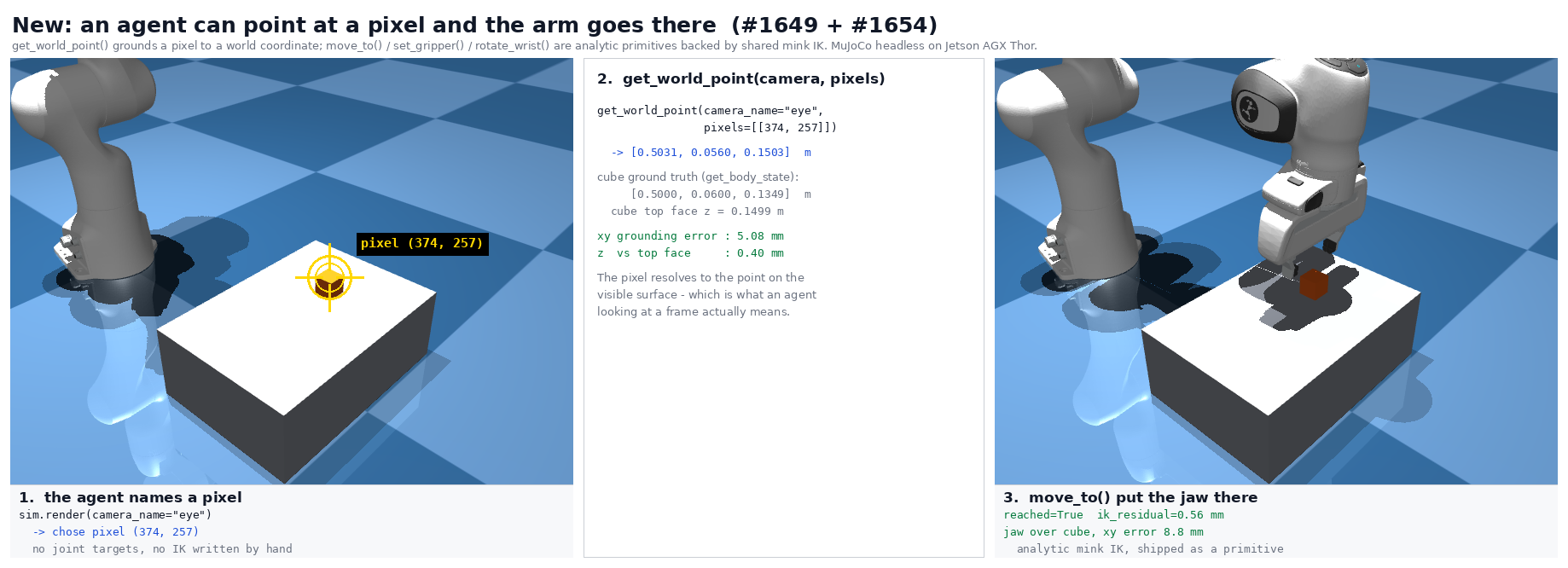
Figure 1 - point at a pixel, the arm goes there (#1649 + #1654).
Left: the frame the agent saw, with the single pixel it named - no hand-written joint
targets. Middle: get_world_point unprojects that pixel and the result is compared
against the cube's privileged pose; the pixel resolves to the point on the visible
surface, which is what "looking at a frame" actually means. Right: move_to
drives the jaw to that coordinate and reports its IK residual. Rendered headless
(MUJOCO_GL=egl) against the tagged source.
stop_when= semantic early-return
run_policy(stop_when={"predicate": "grasped", ...}) terminates the rollout as soon as
the world reaches the predicate state (checked every control step, on both the
synchronous and async-RTC paths), and reports stopped_reason ∈
predicate | budget | cancelled | error plus steps_used. This turns a rollout into a
retryable primitive an agent can stage → invoke → inspect → re-invoke, and composes with
recording (the recorded episode's frame count equals steps_used).
Remote policy inference
A client/server split (strands_robots/inference/) so an edge robot can drive a policy
that runs on a remote GPU. lerobot_async gained a rename_map for remote
observation-key remapping and now forwards it to the PolicyServer, and a numeric
handshake (set_control_frequency / set_rtc_observed_delay) is validated at the call
rather than mid-rollout.
LeRobot 0.6 policies
The [lerobot] and [molmoact2] extras now require lerobot>=0.6.0,<0.7.0 (was
>=0.5.0,<0.6.0), and the 0.5.1-era torch/torchcodec overrides are dropped - lerobot
0.6 ships mature, platform-correct dependency pins of its own.
MolmoAct2installs from PyPI.MolmoAct2Policyships in lerobot 0.6 (lerobot
PR #3604), sopip install 'strands-robots[molmoact2]'resolves it directly - the old
"install lerobot from source" step, thetransformers==5.3.0pin, and the
lerobot[smolvla]==0.5.1guidance are all gone.- The policy resolver covers the full lerobot 0.6.x family -
pi0,pi0.5,
pi0_fast,SmolVLA,MolmoAct2,ACT,Diffusion, and the newereo1/
vla_jepa- with a regression guard so a family a future lerobot release adds is
picked up automatically. Bothlerobot_async's server-supported set and the training
expert_onlyset are sourced live from lerobot rather than a hard-coded list that
drifts. expert_onlyfine-tuning (freeze the VLM, train only the action expert) is now
gated per policy: a run is allowed iff that policy's lerobot config actually declares a
train_expert_onlyfield, instead of against a fixed{pi0, pi05, pi0_fast, smolvla}
tuple (PI0FASTConfig, for one, exposes no such field).- RTC seam documented honestly -
run_policy(async_rtc=...)no longer claims
SmolVLA/MolmoAct2 blend the chunk seam internally; the publiclerobot/smolvla_base
shipsrtc_config=Noneand MolmoAct2 has none, so the library's own real-time-chunking
path is what joins the seam.
Locomotion & terrain curricula
- Terrain heightfields -
create_world(terrain="stairs"|"slope"|"rough"|"pyramid", difficulty=...)as a curriculum knob a locomotion trainer ramps across resets, plus
get_ground_height(x, y)to query the local surface, floating-base seating on the
terrain surface, and terrain-relative reward measurement. - Reward/predicate DSL -
base_velocity,base_height,base_orientation,
base_lin_vel_z/base_ang_vel_xy,base_velocity_trackingreward terms; and
base_beyond_x/y,base_yaw_beyond,base_below_z,base_tippedpredicates. - Shipped benchmarks -
go2_walk_forward,go2_strafe_left,go2_turn_left,
g1_walk_forward,t1_walk_forwardvia `register_buil...
strands-robots v0.4.1
strands-robots 0.4.1
GR00T Whole-Body-Control for the Unitree G1, PPO/FastSAC RL stack
with deterministic eval, LeKiwi in sim, and hard hot-path correctness fixes
(RTC sim/real parity, no silent open-loop rollouts, persistent-policy perf).
416 commits since v0.4.0. All clips rendered headless in MuJoCo (MUJOCO_GL=egl)
against the exact source being tagged.
Highlights at a glance
| Feature | What it does | Demo |
|---|---|---|
| Whole-Body Control | WBCPolicy wraps NVIDIA GR00T SONIC ONNX controllers for deploy-grade G1 locomotion - in-process ONNX (no torch, no sidecar). |
 |
| WBC + steering | Balance + walk ONNX sessions auto-selected by commanded speed; yaw while walking. |  |
| RL from scratch | PpoTrainer, FastSacTrainer, VecSimEnv, BaseRLAlgo.evaluate(). FastSAC learns SO-100 reach from reward alone (−8.77 → −5.50). |
 |
| LeKiwi in sim | Robot("lekiwi", mode="sim") now works - auto-downloads Ekumen-OS description (6-DOF arm on 3-omniwheel base). |
 |
1. Whole-Body Control
Non-VLA provider wrapping GR00T Whole-Body-Control (SONIC / decoupled-WBC) ONNX
controllers. Faithful 86-dim observation stacked over 6 steps, two ONNX sessions
(balance + walk) auto-selected by commanded speed, upstream PD-to-torque law.
from strands_robots import Robot

g1 = Robot("unitree_g1", mode="sim", backend="mujoco")
g1.run_policy(
    policy="wbc",                 # GR00T SONIC whole-body controller
    command={"vx": 0.5},          # forward 0.5 m/s
    duration=6.0,
)
# forward walk: base +2.30 m, pelvis height 0.74 -> 0.75 m (upright, no fall)| vx | omega | result | |
|---|---|---|---|
| Forward walk | 0.5 m/s | 0.0 | +2.30 m, stays upright |
| Walk + yaw | 0.3 m/s | 0.4 rad/s | steers while balanced |
Weights: nepyope/GR00T-WholeBodyControl_g1 (NVIDIA Open Model License).
2. Reinforcement learning constructs
New strands_robots.training.rl stack. VecSimEnv runs N SimEnv as one
(N,D)-batched env over one reused thread pool. evaluate() is a deterministic
eval peer of train() - mean action, frozen normalizer, reports success_rate.
from strands_robots.training.rl import FastSacTrainer, VecSimEnv

env = VecSimEnv("so100", n_envs=8, task="reach")
trainer = FastSacTrainer(env)
trainer.train(iterations=80)          # CPU: mean return -8.77 -> -5.50
stats = trainer.evaluate(episodes=10) # deterministic: elbow 0.225 vs target 0.200
Also: SARM reward-model training + RA-BC production loop.
3. LeKiwi - now simulatable
from strands_robots import Robot

kiwi = Robot("lekiwi", mode="sim")   # was: "No model found"
# auto-downloads Apache-2.0 Ekumen-OS/lekiwi MuJoCo description
# 6-DOF SO-ARM on 3-omniwheel base (9 actuators), front/wrist cameras
4. Hot-path correctness (contract fixes - deploy-critical)
| Fix | Before | After |
|---|---|---|
| RTC sim/real parity | hardware loop ignored Real-Time Chunking contract | loop honours RTC; inference_delay forwarded to denoiser; chunk-seam re-anchored for relative-action policies. Async-RTC latency masking now default |
| No silent open-loop | state-key mismatch -> silent zero/open-loop rollout | loud error; routing-degradation telemetry (positional_fallback_used, generic_state_keys_used) in run_policy/eval_policy JSON |
| Episode-count contract | ambiguous | run_policy episode count + verify_dataset_episodes; reset() during recording flushes buffered episode |
| PersistentPolicy | reloaded heavy checkpoints per call | resident worker + cache controls + policy_resident_rss_mb telemetry |
| Clean errors | partial stub shadowed lerobot.policies; cached transient probe failures |
unknown policy types raise clean ImportError; probes no longer cache transient failures |
get_mass_matrix |
broke on MuJoCo mj_fullM signature change |
works across signatures; numpy scalars retained in state/action vectors |
5. Newton backend maturation
Scene-discovery + per-joint state parity with MuJoCo, domain randomization +
sensor-noise hooks, recording fix (camera frames captured even when policy skips images).
6. Security hardening
Output-path sandboxing across all three LLM-supplied filesystem sinks -
render(output_path=), run_policy(video=), start_cameras_recording -
centralized in simulation.safe_output: rejects .. traversal, backslash
separators, shell metacharacters, symlinked targets before any file opens.
Atomic writes; size caps.
7. Ergonomics / correctness
add_objectrejects unknown kwargs with a structured error (was: silent grey default).- Zero-config robot discovery from
robot_descriptionsin the registry. - Simulation render output is ASCII-only; unified "no world" guard contract.
Media (higher-quality MP4 originals)
| Clip | GIF | MP4 |
|---|---|---|
| G1 WBC walk | gif | mp4 |
| G1 WBC turn | gif | mp4 |
| LeKiwi drive | gif | mp4 |
| RL reach rollout | gif | mp4 |
Assets on branch release/0.4.1-visuals under release-assets/0.4.1/.
Full changelog: git log v0.4.0..v0.4.1 once tagged, or compare/v0.4.0...main.
strands-robots v0.4.0
strands-robots v0.4.0
150+ commits since v0.3.8 (Feb 20). This is the release where strands-robots
stops being "policy inference glue for a single arm on your desk" and becomes a
platform you can simulate on, evaluate on, and deploy to a fleet with - without
swapping libraries at each stage. The through-line of this cycle was closing the gap
between "it runs a model" and "it runs a robot you'd trust in a room with people."
Python >=3.12 required (LeRobot >=0.5.0 floor).
pip install strands-robots· everything:pip install "strands-robots[all]"
The story of this release
Three forces drove almost every PR:
-
The sim-to-real loop was broken in the middle. You could load a policy and you
could talk to hardware, but there was no first-class simulator in between - so you
couldn't develop a policy without a physical robot, and you couldn't reproduce a
failure without the exact bench setup. We built a MuJoCo backend and aRobot()
factory so the same code path runs in sim and on metal. -
"One robot" assumptions don't survive contact with a fleet. The moment more than
one robot, or more than one operator, is involved, you need identity, presence,
replay protection, an audit trail, and a human able to hit stop. We built the mesh
and its AWS IoT transport around that reality, and spent a large fraction of the
cycle hardening it rather than adding surface. -
"It produced an action array" is not "it succeeded." We added a real evaluation
protocol (LIBERO) so policy quality is a number we can defend, not a vibe from
watching a render.
Everything below ladders up to one of those three.
Simulation: so you can develop without a robot on the bench
Why: Iterating on a policy against physical hardware is slow, unsafe, and
unreproducible. A bug that only shows up at 50 Hz on a real servo is nearly impossible
to bisect. We needed a simulator that is byte-equivalent enough to trust and that
exposes the same agent-tool surface as the rest of the library.
- MuJoCo backend as an
AgentToolwith 50+ actions (#85) on a foundation of
models, thePolicy/engine ABCs, a factory, a model registry, and asset
auto-download (#84, #105/#106). The agent drives the world the same way it drives a
real robot - world building, robot inject/eject, cameras, stepping, rollout, render. - Control-rate substepping (#353) and stepping physics for the full control
period in eval (#429). Why it matters: position-servo policies were silently
failing to track because we stepped the sim once per action instead of for the whole
control interval - the policy looked broken when the integration was. This is the
kind of bug that costs a week on hardware; we paid it down once, in sim. - Render fidelity fixes - blown-out white ground (#428), ground-plane z-fighting on
attach (#360), conditional ground-strip + tendon scale + RNG parity (#400).
Why it matters: renders are the policy's input in vision models. A blown-out
frame isn't cosmetic - it's feeding the policy garbage and poisoning eval. - Naming/identity correctness: register sim robots under the user's name not the
canonical one (#435), structured errors from resolvers (#417), optionalrobot_name
across the state family (#412). Why: the sim has to address robots the way the user
thinks about them, or multi-robot scenes become a guessing game. SimEngine.describe()discovery surface (#407) - so an agent can ask "what can I do
here?" instead of failing on an unknown action key. We also started surfacing valid
actuator names on errors and propagating failures intorun_policystatus (#436),
because a silent zero-action on failure is the single most dangerous default in robotics.
Robot() factory: one entry point
Why: Before this, choosing sim vs. real meant choosing a different code path, and
the path that touches a physical motor was just as easy to invoke by accident as the
safe one. That's backwards.
Robot()factory + top-level lazy imports (#86; hygiene follow-ups #145).
Sim is the default; real hardware is an explicit opt-in (mode="real"/
STRANDS_ROBOT_MODE=real). Lazy imports keepimport strands_robotscheap so the
factory doesn't drag the entire ML stack into a process that just wants to talk to a
serial port.- Ergonomics for
send_action,add_robot,render,get_robot(#431) - the
paper cuts that make the difference between an API you demo and an API you live in.
Mesh + AWS IoT: because a fleet is a security problem, not a networking problem
Why: Connecting robots is easy. Connecting robots safely - where a stale command
can't be replayed, a compromised peer can't impersonate another, an operator can always
intervene, and every actuation is on an audit trail - is the actual job. We treated the
mesh as a trust boundary from day one, which is why the hardening PRs outnumber the
feature PRs here.
- Core mesh - session, presence, RPC, streams, wiring, + AWS IoT transport (#101).
Zenoh for the LAN, MQTT5/mTLS for the cloud, Device Shadow mirror, S3 camera offload,
account-wide Fleet Provisioning. - The #195 hardening split landed as a deliberate sequence so each layer could be
reviewed in isolation: PKI helpers + conftest (#220), payload validation / action
allowlist (#223), Zenoh + ACL config with mTLS/downsampling/low-pass (#224),
tamper-evident HMAC audit log with per-peer sequence + rotation (#221), cross-transport
dedup + monotonic TTL + strict mode (#222), replay caches + override-resume + safety
topic handlers (#225), and robot_mesh HITL viatool_context.interrupt+ per-action
rate limit (#227). Why split: security review fatigue is real; a 9-part series each
reviewable in an afternoon catches more than one 4000-line PR nobody reads to the end. - Human-in-the-loop done right (#227, #411): a declined approval must not consume a
rate-limit slot (or an operator's "no" could lock out a legitimate e-stop), and the
operator's literal reply is never echoed back into the LLM context (that turns a human
into a prompt-injection channel). Read-only actions are audited too (#411) - operators
need "the agent read N frames at time T", not just actuation logs. - Replay/lockout safety pins: estop engages even when the per-issuer replay cache is
full (#263/#339) - the cache bounds memory, never safety; resume-cache fairness mirror
(#342); check-then-set estop replay lock (#273/#361); poison records on every degraded
audit path so a stream gap is attributable, not silent (#410). Why this obsession:
in this domain the failure mode isn't "wrong answer", it's "arm moves when it shouldn't"
or "stop didn't take." Fail-loud, fail-safe, always. - AWS IoT provisioning hardening: CA pin + thing-name regex + scoped policy (#228),
deny-by-default Fleet Provisioning hook (#333), operator-shadow + response publishes
scoped to the device's own ThingName (#334, #336), atomic break-glass marker with
explicit symlink reject (#388/#402). Why: fleet provisioning is the blast radius -
a permissive default here means one bad cert owns the whole account. - Teleop integrity: validate input frames before apply (#332), route every teleop
publish through the singleMesh.publish()chokepoint (#452). One door, guarded. - Sim is a first-class mesh peer:
tell()dispatch maps torun_policy/start_policy
(#304), sim joint state bridges to child peers (#422), sim cameras publish JPEG frames
(#425). Why: if sim and real don't look identical on the mesh, your fleet tooling
can't be tested in sim - which defeats the point of having a sim.
Policies: more brains, one socket
Why: The field is moving fast and no single policy wins everywhere - VLAs for
open-ended manipulation, classical planners for collision-aware motion. The Policy ABC
exists so adding a new brain doesn't fork the stack. This cycle we proved the abstraction
holds by hanging very different things off it.
- NVIDIA Cosmos 3 omnimodal VLA (#317) with both a service backend (msgpack/websockets,
GPU-isolated) and an in-processdiffusersbackend (#458) for when you'd rather not
run a sidecar. We re-anchor IK on the achieved EE pose each step (#462) - why: over a
long rollout, integrating the model's relative pose deltas drifts; anchoring on where the
arm actually is bounds the tracking error instead of letting it compound. - MoveIt2Policy under
[moveit2](#305) and cuRobo migrated to themainAPI
(#442) - collision-aware planners living under the same ABC as the VLAs, so an agent can
choose "plan a safe path" vs. "imitate" without changing how it calls a policy. - GR00T N1.7 EA (#93) plus the unglamorous-but-essential wire-format fixes: service
(B, T, ...)shape + float32 state (#149), container lifecycle (#152), command-builder
flags (#150, #155). Why these are in a release at all: an off-by-one in the observation
tensor shape doesn't error - it silently degrades inference. Pinning the wire format is
what makes "GR00T support" a claim instead of a hope. - LeRobot local direct-HF inference with RTC (#56), device-resolution + postprocessor
warnings (#430), and the LeRobot 0.5.2 recording pipeline overhaul - synchronized
multi-robot, action-horizon batching, a camera-recorder race fix, full embodiment
coverage (#366). Why: recording is how you get training data; a race in the recorder
is silent data loss you only discover when your dataset trains a worse policy.
Evaluation: turning "looks good" into a number
Why: Without a benchmark, "the policy is better now" is unfalsifiable. We adopted a
benchmark-agnostic eval protocol (#129) and a LIB...
v0.3.8

🤖 Teach a hand once, and it dreams a thousand motions

The full robot lifecycle — collect, dream, train, deploy — unified behind natural language. From every idea, a motion. From every developer, a maker of machines.

Welcome to Strands Robots.