
MCP-native secret scanner — verified findings, agent-applied rewrites.


Go module wrapper around the native leakferret
binary. This module ships no scanning logic of its own: it downloads the
prebuilt, statically-linked binary (written in Rust) from GitHub Releases on
first use, caches it locally, and shells out to it. All the work — scan,
classify, verify, rewrite — happens in that single binary.
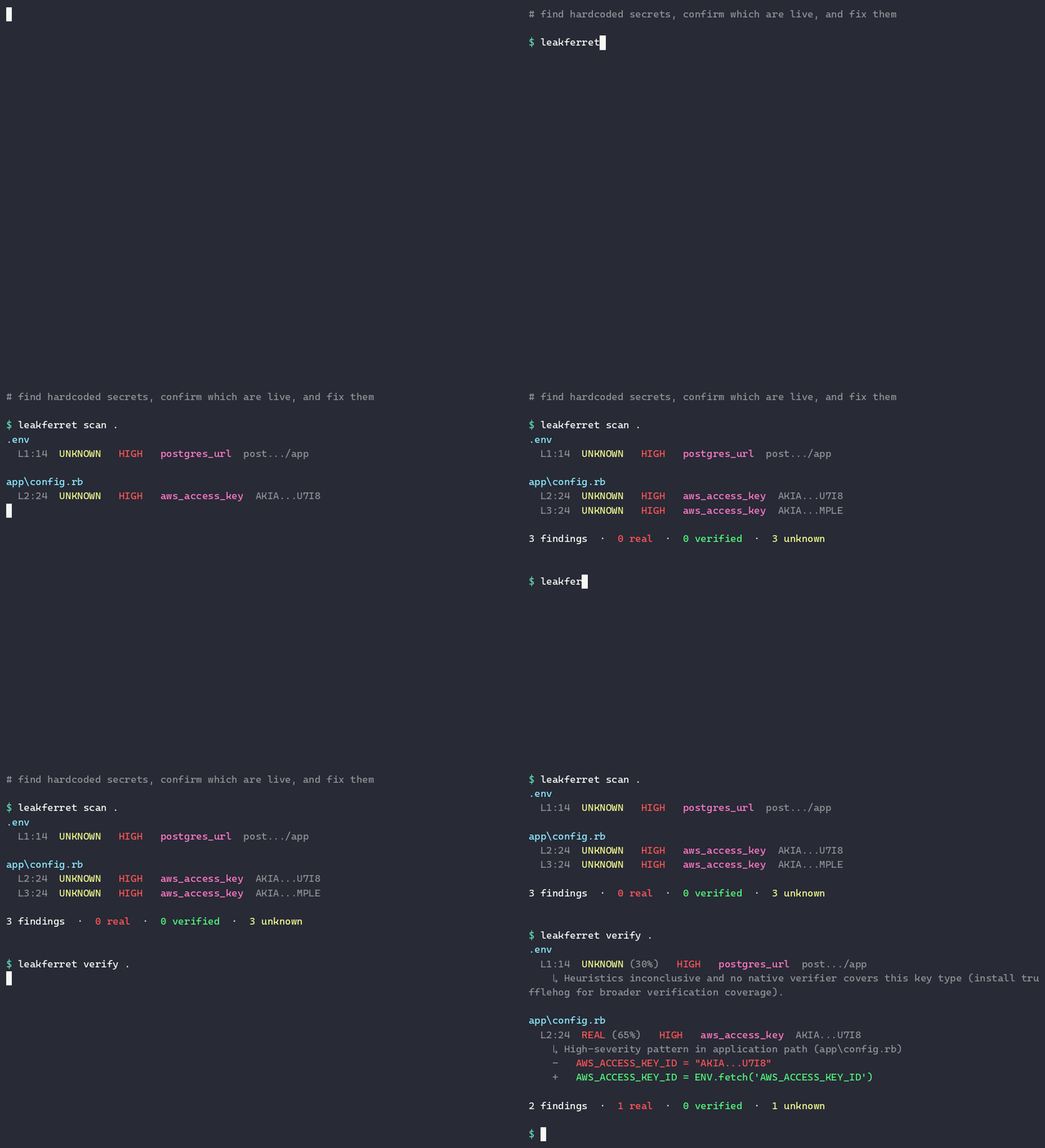
leakferret finds hardcoded secrets and API keys in your code and helps you remove them, in five stations:
- Scan — regex pre-filter over files; respects
.gitignoreand also reads dotfiles like.env. - Catalog — a signed database of known-public example credentials (Stripe
test keys,
AKIAIOSFODNN7EXAMPLE, jwt.io samples) so documented examples are markedFIXTUREinstead of false-alarming. - Classify — a
REAL/FIXTURE/UNKNOWNverdict, from offline heuristics or by asking the host editor/agent language model (no extra API key, no cost). - Verify — a real but harmless API call to the provider (AWS SigV4, GitHub, GitLab, Stripe, OpenAI, Anthropic, Slack, Twilio, SendGrid, Mailgun, Datadog, Heroku, npm, PyPI, DigitalOcean) to confirm a key is live, plus a trufflehog fallback.
- Rewrite — swap a hardcoded literal for an environment-variable lookup,
add a
.env.exampleline, and print secret-manager seed commands.
Privacy invariant: the full secret value never leaves your machine. Only a
redacted first-4-plus-last-4 preview (e.g. AKIA...4XYZ) is ever written to a
report, log, network message, or model prompt. Verification calls go straight
from your machine to the provider — leakferret has no servers.
As a CLI:
go install github.com/leakferrethq/leakferret-go/cmd/leakferret@latest
leakferret scan .
As a library:
go get github.com/leakferrethq/leakferret-goRequires Go 1.22+.
The installed leakferret command exposes the full upstream interface:
leakferret scan .
leakferret verify . --only-verified
leakferret rewrite . --apply --backend doppler
leakferret baseline init
leakferret catalog info
leakferret mcp                 # MCP server on stdio
leakferret scan --git walks commit history. Output formats are pretty,
json, and sarif (for GitHub Code Scanning).
package main

import (
    "context"
    "fmt"
    "log"

    leakferret "github.com/leakferrethq/leakferret-go"
)

func main() {
    ctx := context.Background()
    findings, err := leakferret.Verify(ctx, ".",
        leakferret.WithVerifyMode(leakferret.VerifyModeOnlyVerified))
    if err != nil {
        log.Fatal(err)
    }
    for _, f := range findings {
        fmt.Printf("%s:%d %s [%s] %s\n",
            f.Path, f.Line, f.Pattern, f.Verdict, f.MatchRedacted)
    }
}
The first call resolves the host target triple, downloads the matching binary from GitHub Releases, and caches it. Subsequent calls reuse the cache.
-
LEAKFERRET_BIN— absolute path to a pre-positioned binary. Set this and the module runs it directly, skipping the download and cache entirely. Every leakferret wrapper honors this variable; it is the recommended path for air-gapped or offline environments.export LEAKFERRET_BIN=/opt/leakferret/leakferret -
Cache locations (used when
LEAKFERRET_BINis unset):$XDG_CACHE_HOME/leakferret/$LOCALAPPDATA/leakferret/cache/(Windows)~/Library/Caches/leakferret/(macOS)~/.cache/leakferret/(Linux fallback)
The module installs a leakferret binary you can call in any pipeline
(exit 0 = clean, 1 = findings):
go install github.com/leakferrethq/leakferret-go/cmd/leakferret@latest
leakferret baseline init      # commit the baseline so CI fails only on NEW secrets
leakferret verify .           # exits 1 on any REAL finding
On GitHub use the action;
on CircleCI / GitLab / Argo / Jenkins the recipe is identical. --format sarif
for a report, --only-verified to fail only on confirmed-live keys.
The same binary is an MCP server, so a coding agent (Cursor, Claude, Continue) can scan, verify, and rewrite before it commits:
{ "mcpServers": { "leakferret": { "command": "leakferret", "args": ["mcp"] } } }Cursor: Settings → MCP. Claude Desktop: claude_desktop_config.json. Running
leakferret mcp in a terminal looks like a hang — that's correct, it's a stdio
JSON-RPC server waiting for the editor to connect.
Prebuilt binaries are published for x86_64-unknown-linux-gnu,
x86_64-apple-darwin, aarch64-apple-darwin, x86_64-pc-windows-msvc, and
aarch64-pc-windows-msvc. Linux ARM64 (aarch64-unknown-linux-gnu) is not yet
published; on that platform, build the engine from source and point
LEAKFERRET_BIN at it.
Catch a secret before it is ever committed. From your repo root:
cat > .git/hooks/pre-commit <<'HOOK'
#!/bin/sh
# Offline secret scan (no network). Blocks the commit on any finding.
leakferret verify . --verify-mode none --fail-on any || {
  echo "leakferret blocked this commit. Bypass: git commit --no-verify"
  exit 1
}
HOOK
chmod +x .git/hooks/pre-commit
--verify-mode none keeps it offline; --fail-on any exits non-zero on any
non-fixture finding (documented examples like AKIAIOSFODNN7EXAMPLE are still
ignored). Pair with leakferret baseline init to block only on new secrets,
or commit the hook to .githooks/ and run git config core.hooksPath .githooks
to share it with a team.
MIT for this module and the bundled binary. The fixture catalog data is
CC-BY-SA-4.0 — see leakferret-catalog.
Part of leakferret · leakferret.com · maintained by Maria Khan <missusk@protonmail.com>.