This is the repository to generate ready-to-use bluenoise sampling SSBO data for your Iris shaders.
I wrote this originally to use in my Lyrae Shaderpack. If you use it and find it helpful, I'd appreciate attribution.
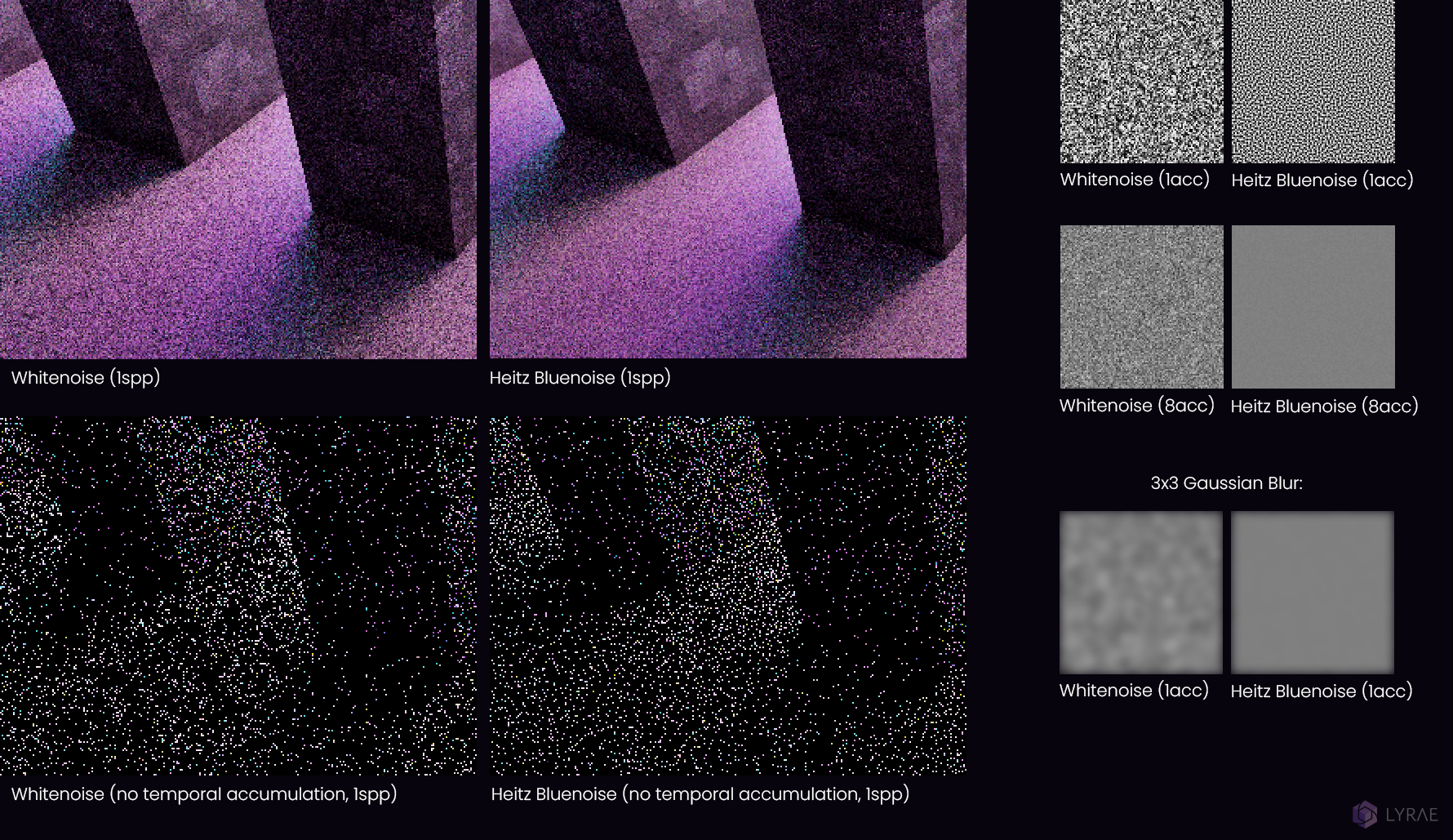
You can see my findings on different noise methods and how it affects a path traced sc ene.
This is meant to be used in path tracers or other graphical stochastic applications where Monte-Carlo sampling error exists.
Usually at low sample amounts Monte-Carlo produces high-variance and dissimilar pixels which results in white noise. Heitz et al (see references) provides a solution that uses a low-discripancy sampling method to distribute error as blue noise.
Make sure you have Python 3.12+ installed. Clone the repository and enter it.
$ git clone https://github.com/kadir014/iris-heitz-bluenoise-gen.git
$ cd iris-heitz-bluenoise-gen
Run the generator with the required spp amount (you can also use -h). It is going to generate the SSBO file which you can simply plug in and use in your Iris shaders.
$ python gen.py <spp>First you need to tell Iris to load in the SSBO file.
#// SSBO size = 128 * 128 * 8 * 2 + 256 * 256
bufferObject.X = 1310720 data/heitz_bluenoise_Nspp.ssbo
In the shader pass you're going to sample bluenoise, you need to define the same SSBO layout with the index. The order is the same as the data file.
layout(std430, binding = X) readonly buffer BluenoiseLayout {
    int heitz_ranking[131072]; // 128 * 128 * 8
    int heitz_scrambling[131072]; // 128 * 128 * 8
    int heitz_sobol[65536]; // 256 * 256
};
And finally, you can use heitz_sample function with the correct state for bluenoise sampling. (The code is directly from the paper, modified slightly to be used in GLSL.)
ivec2 heitz_state_pixel;
int heitz_state_sample;
int heitz_state_dimension;

float heitz_sample() {
    int pixel_i = heitz_state_pixel.x;
    int pixel_j = heitz_state_pixel.y;

    // Wrap arguments
    pixel_i = pixel_i & 127;
    pixel_j = pixel_j & 127;
    int sample_idx = heitz_state_sample & 255;
    int sample_dim = heitz_state_dimension & 255;

    // XOR index based on optimized ranking
    int ranked_sample_idx = sample_idx ^ heitz_ranking[sample_dim + (pixel_i + pixel_j * 128) * 8];

    // Fetch value in sequence
    int value = heitz_sobol[sample_dim + ranked_sample_idx * 256];

    // If the dimension is optimized, xor sequence value based on optimized scrambling
    value = value ^ heitz_scrambling[(sample_dim % 8) + (pixel_i + pixel_j * 128) * 8];

    // Increase dimension after each call
    // Uncomment this if you have temporal accumulation
    // heitz_state.dim += 1;

    return (0.5 + float(value)) / 256.0;
}This repository wouldn't be possible without E. Heitz's work. Please check out their paper:
- E. Heitz et al — A Low-Discrepancy Sampler that Distributes Monte Carlo Errors as a Blue Noise in Screen Space
GNU GPL v3 © Kadir Aksoy