A minimalist Hugo theme inspired by Swiss editorial design, built for technical writing, engineering notes, and high-clarity personal blogs.
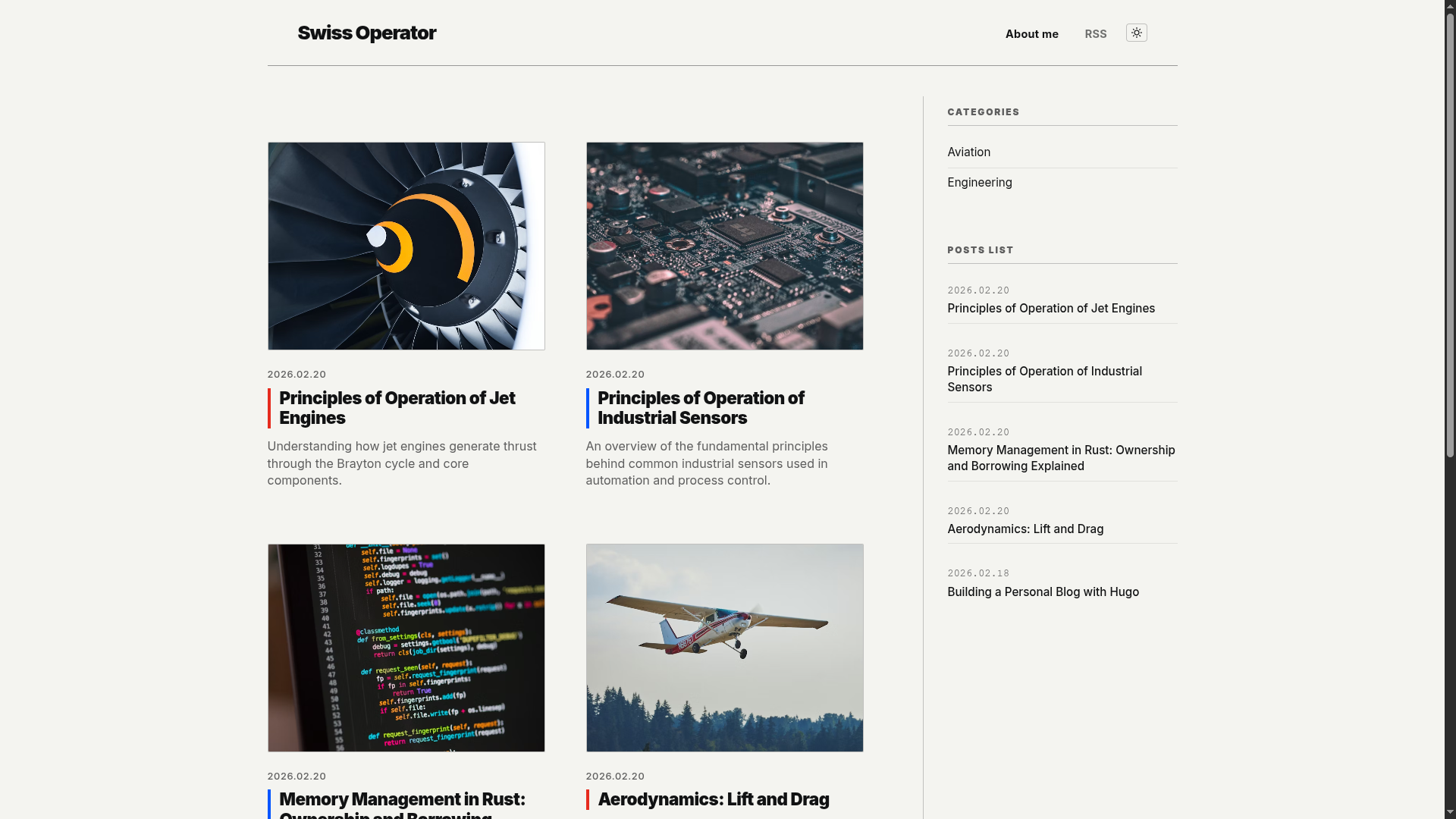
| Light | Dark |
|---|---|
 |
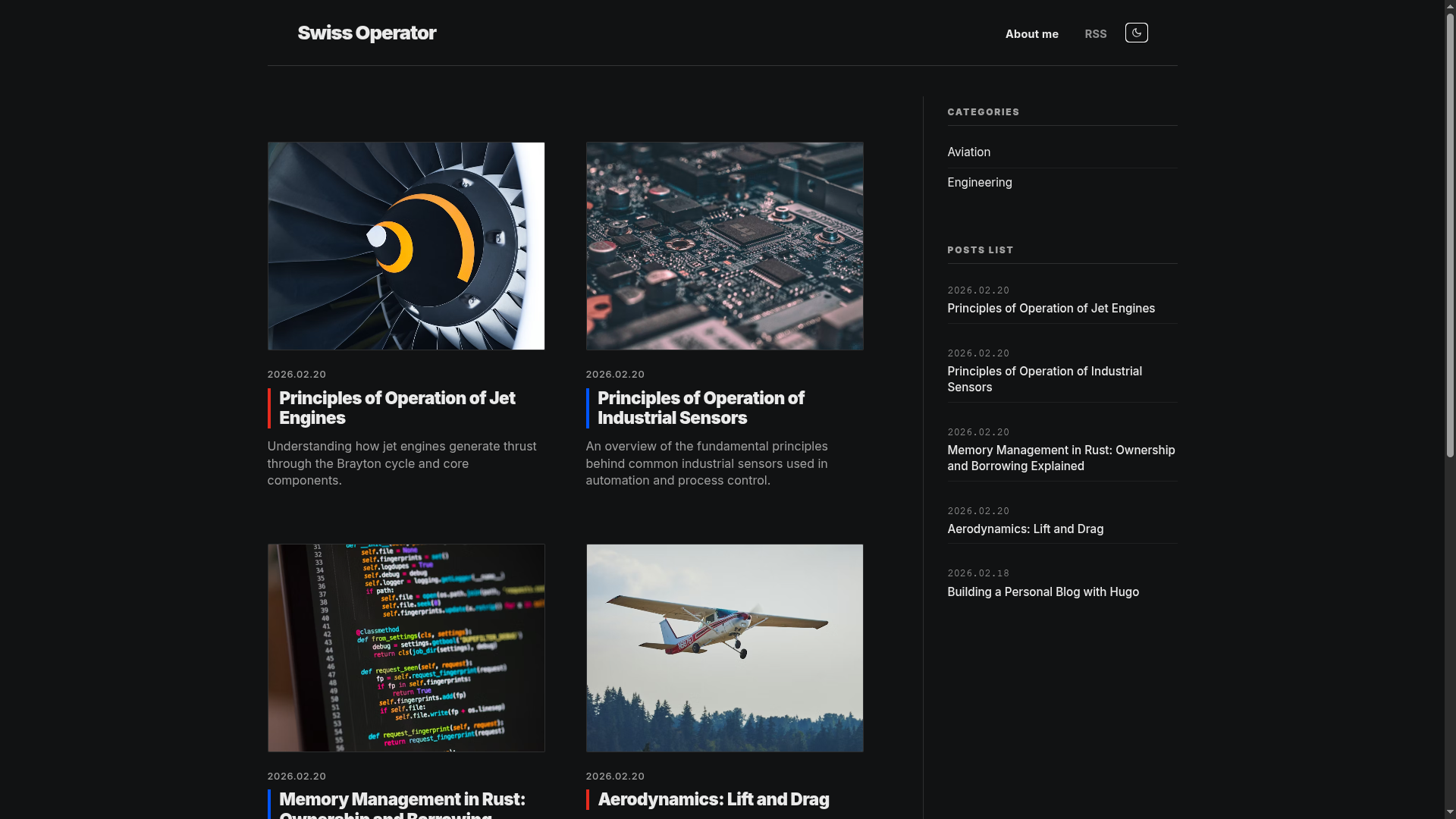 |
The design prioritizes legibility, typographic rhythm, grid consistency, and structural alignment - the same principles that make Swiss editorial design reliable in print. These qualities matter most in contexts where precision is non-negotiable: engineering notes, technical documentation, and working knowledge bases where the content has to carry its own weight.
No gradients, no hero sections, no visual noise. Just a clean reading surface and a layout that stays out of the way.
"Good design is as little design as possible." - Dieter Rams
- Swiss editorial aesthetic - bold typography, tight grid, deliberate whitespace
- Dark / light mode - auto-detects system preference; toggle persists via
localStorage - Responsive layout - 70/30 two-column grid collapses to a single column on mobile
- Category color coding - assign a hex color to each category; shown as a left border accent on post cards
- Customizable accent colors - override the default Blueprint Blue and Safety Red from
hugo.toml - Multi-language - ships with English, Spanish, and French i18n strings
- Local or Google Fonts - load Inter + JetBrains Mono from Google Fonts or self-host them
- RSS feed - enabled for home and section pages out of the box
- Google Analytics - optional GA4 support via Hugo's built-in integration
- Remark42 comments - optional self-hosted comment system with automatic dark/light sync
- Favicon support - SVG, PNG, ICO, and JPEG
- Hugo 0.110.0+
- Go 1.21+ (only required for Hugo Modules installation)
git submodule add https://github.com/carlosplanchon/hugo-theme-swiss-operator themes/swiss-operatorSet the theme in your hugo.toml:
theme = 'swiss-operator'Download or clone this repository into your site's themes/swiss-operator/ directory, then set theme = 'swiss-operator' in your hugo.toml.
Copy the example site to bootstrap your configuration:
cp -r themes/swiss-operator/exampleSite/* .Then run:
hugo serverBelow is a full annotated hugo.toml:
baseURL = 'https://example.com/'
languageCode = 'en-us'
title = 'My Swiss Blog'
theme = 'swiss-operator'

[services.googleAnalytics]
id = "G-XXXXXXXXXX"

[outputs]
home    = ['html', 'rss']
section = ['html', 'rss']

[params]
description  = "A personal blog about your topics"
postsPerPage = 10
favicon      = "/favicon.svg"

# Social links shown in the footer (all optional)
[params.social]
github    = "https://github.com/username"
linkedin  = "https://linkedin.com/in/username"
x         = "https://x.com/username"
instagram = "https://instagram.com/username"
facebook  = "https://facebook.com/username"

[params.theme]
accentBlue  = "#0055FF"   # Left-border accent / link color
accentRed   = "#E62B1E"   # Secondary accent
showRss     = true
localFonts  = false       # true → serve fonts from /assets/fonts/ instead of Google Fonts

# Map category names to hex colors (used as left-border accents on post cards)
[params.categories]
colors = { Engineering = "#0055FF", Aviation = "#E62B1E", Design = "#000000" }

# Optional: Remark42 comment system
# [params.remark42]
# url  = "https://your-remark42-instance.com"
# site = "blog"

# Navigation menu
[[menu.main]]
  name   = "About"
  url    = "/about/"
weight = 1---
title: "My Post Title"
date: 2024-01-15
description: "A short summary shown on the post card."
categories: ["Engineering"]
image: "/images/my-cover.jpg" # optional cover image
draft: false
---categories- the first category determines the card's accent color.image- displayed as a 4:3 cover image on the post card.description- shown as the card subtitle on the home page.
| Role | Typeface |
|---|---|
| Body & headings | Inter |
| Dates, code, metadata | JetBrains Mono |
To self-host both fonts, set localFonts = true in [params.theme]. The font files are already bundled under assets/fonts/.
The theme ships with i18n/en.toml, i18n/es.toml, and i18n/fr.toml. To add another language, create a new file in your site's i18n/ directory following the same keys.
Uncomment and fill in the [params.remark42] block in hugo.toml. The comment widget automatically inherits the active light/dark theme.
[params.remark42]
url  = "https://comments.example.com"
site = "myblog"