


Each line of a paragraph oscillates its letter-spacing — or variable font axis — at a phase offset from its neighbours. Two modes: phase gives each line a fixed ripple at a staggered point in the cycle; tide sends a traveling wave through the paragraph from top to bottom. At low amplitudes it reads as living rather than animated.
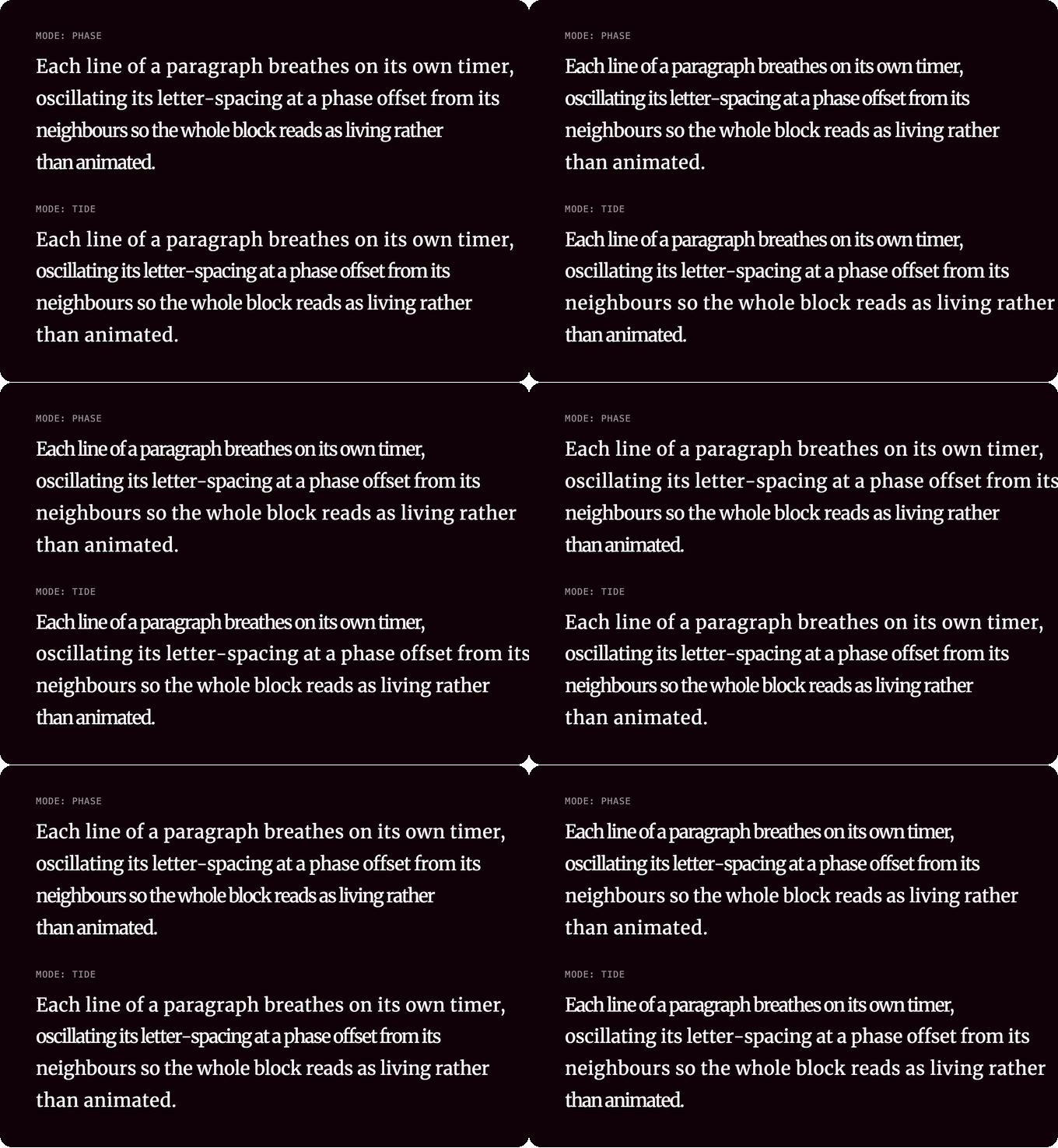
Amplitude exaggerated for the demo — the 0.012 default is far subtler. Generated from the shipped bundle by scripts/capture.mjs.
textbreath.com · npm · GitHub
TypeScript · Zero dependencies · React + Vanilla JS
npm install @liiift-studio/textbreathNext.js App Router: this library uses browser APIs. Add
"use client"to any component file that imports from it.
import { BreatheText } from '@liiift-studio/textbreath'

<BreatheText amplitude={0.012} period={3.5} phaseOffset={0.785} linePreservation="clamp">
  Your paragraph text here...
</BreatheText>
linePreservation="clamp" constrains each line to its natural width so the breathing effect stays within the line box. Omit it if very small overflow at the line edge is acceptable.
import { useBreathe } from '@liiift-studio/textbreath'

// Inside a React component:
const ref = useBreathe({ amplitude: 0.012, period: 3.5, phaseOffset: 0.785 })
return <p ref={ref}>{children}</p>
The hook starts the animation loop on mount, re-runs line detection on resize via ResizeObserver, and re-runs after fonts load via document.fonts.ready. Cleans up on unmount.
applyBreathe wraps lines and returns them. startBreathe drives the animation loop and returns a stop function.
import { applyBreathe, startBreathe, removeBreathe, getCleanHTML } from '@liiift-studio/textbreath'

const el = document.querySelector('p')
const original = getCleanHTML(el)
const opts = { amplitude: 0.012, period: 3.5 }

let { lineSpans } = applyBreathe(el, original, opts)
let stop = startBreathe(lineSpans, opts)

document.fonts.ready.then(() => {
  stop()
  lineSpans = applyBreathe(el, original, opts).lineSpans
  stop = startBreathe(lineSpans, opts)
})

// On resize — stop, re-detect lines, restart:
const ro = new ResizeObserver(() => {
  stop()
  const { lineSpans: newSpans } = applyBreathe(el, original, opts)
  stop = startBreathe(newSpans, opts)
})
ro.observe(el)

// Later — stop the animation loop and restore the DOM:
stop()
ro.disconnect()
removeBreathe(el, original)import type { BreatheOptions } from '@liiift-studio/textbreath'
const opts: BreatheOptions = { amplitude: 0.012, period: 3.5, mode: 'tide' }| Option | Default | Description |
|---|---|---|
amplitude |
0.012 |
Peak change per cycle. Em units for letter-spacing. For wdth, the axis value becomes 100 ± (amplitude × 100). For wght, it becomes 400 ± (amplitude × 400). As a feel guide: 0.012 is barely perceptible (the "living, not animated" default); ~0.03–0.05 reads as an obvious shimmer; above that the line-width change becomes pronounced — pair with linePreservation: 'clamp' |
period |
3.5 |
Seconds per full oscillation cycle |
phaseOffset |
π/4 ≈ 0.785 |
Radians of phase shift between adjacent lines. Used in 'phase' mode only |
waveShape |
'sine' |
'sine' | 'triangle' | 'sawtooth' |
pauseOffscreen |
true |
Pause the rAF loop via IntersectionObserver when the element is fully scrolled offscreen. Set to false to keep animating at all times |
cancelOffscreen |
false |
Cancel the rAF loop entirely when the element leaves the viewport and restart on re-entry. Saves more CPU than the default flag-based pause. Adds one frame (~16 ms) of delay on resume. Requires pauseOffscreen: true |
axis |
'letter-spacing' |
Property to animate: 'letter-spacing' | 'wdth' | 'wght' |
mode |
'phase' |
'phase' — standing ripple, each line at a fixed phase offset. 'tide' — wave travels through the paragraph |
direction |
'down' |
Tide travel direction: 'down' | 'up'. Used in 'tide' mode only |
lineDetection |
'bcr' |
'bcr' reads actual browser layout — ground truth, works with any font and inline HTML. 'canvas' uses @chenglou/pretext for arithmetic line breaking with no forced reflow on resize (npm install @chenglou/pretext). Falls back to 'bcr' while pretext loads |
linePreservation |
'none' |
'none' — lines breathe freely in width (may overflow container at large amplitudes). 'clamp' — each line is constrained to its natural width via max-width and overflow: hidden; the breathing effect is contained within the line box with no container overflow. Characters at the trailing edge clip slightly during the wide phase |
as |
'p' |
HTML element to render. (React component only) |
| Export | Description |
|---|---|
applyBreathe(el, originalHTML, options?) |
Wrap lines in spans and return { lineSpans }. Call once before startBreathe. |
startBreathe(lineSpans, options?) |
Start the rAF animation loop. Returns a stop() function. |
removeBreathe(el, originalHTML) |
Restore the element to its original markup. |
getCleanHTML(el) |
Return the element's inner HTML with all injected spans removed. |
triangleWave(t) |
Triangle wave utility exported for custom animation drivers. |
sawtoothWave(t) |
Sawtooth wave utility exported for custom animation drivers. |
useBreathe |
React hook: (options?) => ref. Starts on mount, cleans up on unmount, re-detects lines on resize. |
BreatheText |
React component. Accepts all BreatheOptions plus as prop. |
BreatheOptions |
TypeScript interface for all options. |
BREATHE_CLASSES |
CSS class names injected by the algorithm (pb-word, pb-line, pb-probe). |
Each visual line is wrapped in a <span>. In phase mode, line i is assigned a fixed phase of i × phaseOffset radians, and the wave is evaluated at that phase each frame. In tide mode, each line's phase advances with both time and its index — the same traveling wave used by Flood Text, but applied to letter-spacing or a variable font axis rather than per-character. Both modes run a requestAnimationFrame loop at consistent speed regardless of display refresh rate. The loop is skipped entirely if prefers-reduced-motion: reduce is set — startBreathe returns a no-op in both the React hook and vanilla JS, so callers get the accessibility guard for free. In React the loop also stops automatically on unmount; in vanilla JS, call the stop function returned by startBreathe to end it.
Line break safety: Line breaks are locked to the browser's natural layout — each applyBreathe call starts from the original HTML, detects lines at natural spacing, then locks them with white-space: nowrap. Word breaks never change during the animation.
Width overflow: Letter-spacing animation causes lines to grow and shrink with the wave. At the default amplitude: 0.012em the peak overflow for a 60-character line at 16px is approximately 11px — typically imperceptible. At larger amplitudes, use linePreservation: 'clamp' to contain the effect within each line box, or add overflow-x: hidden to the element's CSS.
- Size: ~3.5 kB gzipped, zero runtime dependencies. ESM + CJS dual build,
sideEffects: false, tree-shakeable. React and@chenglou/pretextare optional peer dependencies — pulled in only if you use the hook/component or the canvas line-detection path. - Reflow cost: animating
letter-spacing(the default axis) re-runs layout for the line on every frame. For a few short paragraphs this is negligible, but on very long or numerous blocks it is main-thread work. Thewght/wdthvariable-font axes mutatefont-variation-settingsinstead, which is cheaper, andpauseOffscreen(on by default) skips the loop's work while the element is fully scrolled out of the viewport. - Accessibility: respects
prefers-reduced-motion: reducein both React and vanilla; injected line spans arearia-hiddenand the original text is exposed viaaria-label, so screen readers read the paragraph normally. - Requirements: evergreen browsers. Uses
ResizeObserver,IntersectionObserver,requestAnimationFrame, anddocument.fonts.ready. Skips animation on e-ink /(update: slow)displays. Variable-font axes require a variable font;letter-spacingworks with any font.
package.json at the repo root lists next as a devDependency. This is a Vercel detection workaround — not a real dependency of the npm package. Vercel's build system inspects the root package.json to detect the framework; without next present it falls back to a static build and skips the Next.js pipeline, breaking the /site subdirectory deploy.
The package itself has zero runtime dependencies. Do not remove this entry.
- Multi-axis mode — animate both
letter-spacingand a variable font axis simultaneously from a single instance - Scroll-phase mode — tie the wave phase to scroll position rather than time, so the paragraph breathes as the user reads down the page
- Amplitude envelope — fade amplitude in on mount and out on unmount for a softer entrance and exit
Current version is shown by the npm badge above.