CPU source-language detection for code with a tiny 50kb model.
[dependencies]
betlang = "0.1.0"
let detection = betlang::detect("fn main() { println!(\"hi\"); }");
assert_eq!(detection.language(), Some(betlang::Language::Rust));Use betlang::detect(source) for UTF-8 source strings or byte slices. It
returns a Detection; call Detection::language() to read the top language.
Call Detection::top_languages() when you need ranked probabilities.
Slugs parse through the standard FromStr implementation:
assert_eq!("rust".parse::<betlang::Language>(), Ok(betlang::Language::Rust));asm, batch, c, clojure, cmake, cobol, cpp, cs, css, dart,
dockerfile, elixir, erlang, gemfile, gemspec, go, gradle,
groovy, haskell, html, ini, java, javascript, json, julia,
kotlin, lisp, lua, markdown, objectivec, ocaml, perl, php,
powershell, python, r, ruby, rust, scala, shell, sql, swift,
toml, typescript, vba, verilog, xml, yaml.
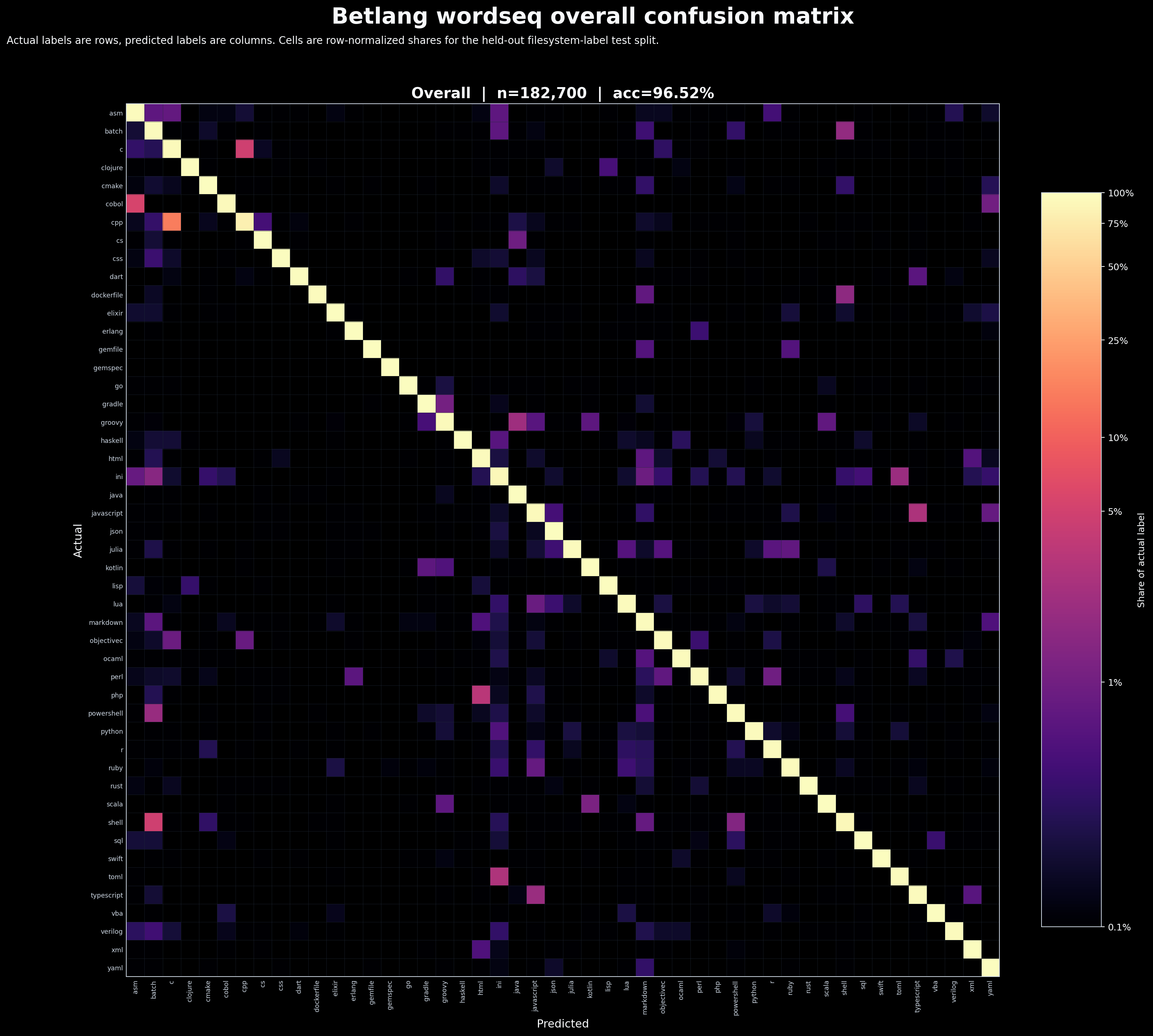
These are the model's 48 output labels. Runtime detections expose them one-to-one with no label aggregation.
The confusion matrix uses the same labels:
The embedded model is assets/magika/source-student-q4.bin, a 47,840-byte
weights-only MSQ1 payload with SHA-256:
59ef24167bddd1364eb9c1650add8a67e1a542b5155fac67f5e1cda07df0c0f0
Architecture: wordseq-b1024-k3-m2048-tiny-3conv-hidden, tokenizer version 3.
On the manifest-aligned held-out filesystem-label test split it reaches
test_fs_accuracy=0.965238 with macro_recall=0.965411.
See MODEL_CARD.md for the training and evaluation summary.
Betlang uses a fixed 4096-byte Magika window and pads runtime inference to the
same 2048-token shape used by evaluation. The model is loaded once per process
and then reused through a OnceLock.
Native CPU inference dispatches through fearless_simd. Benchmark entry points
are available through cargo bench. Current baseline numbers are tracked in
BENCHMARKS.md.
Betlang is licensed under MIT. The embedded student model was trained from outputs of Google's Magika teacher model; Magika is published by Google under Apache-2.0. Keep this attribution with redistributed model artifacts.
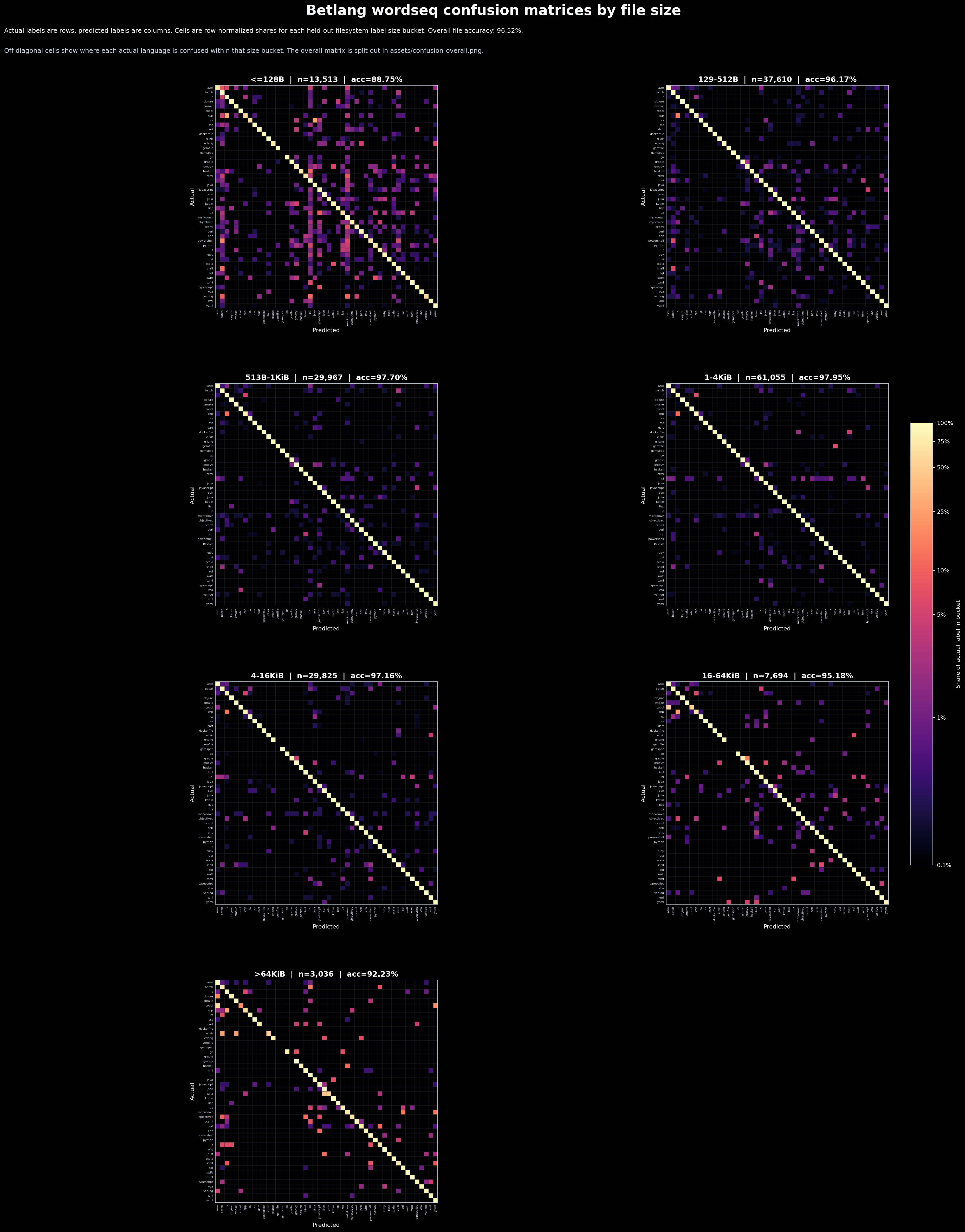
The shipped wordseq model is evaluated below on the held-out bigorig test
split. Each panel is a row-normalized confusion matrix for one file-size
bucket: actual labels are rows, predicted labels are columns, and the diagonal
is correct classification.