╔═══════════════════════════════════════════════════════════════════════════════╗
║ ⠶⠶⠶⠶⠶⠶⠶⠶⠶⠶⠶⠶⠶⠶⠶⠶⠶⠶⠶⠶⠶⠶⠶⠶⠶⠶⠶⠶⠶⠶⠶⠶⠶⠶⠶⠶⠶⠶⠶⠶⠶⠶⠶⠶⠶⠶⠶⠶⠶⠶⠶⠶⠶⠶⠶⠶⠶⠶⠶⠶⠶⠶⠶⠶⠶⠶⠶⠶⠶⠶⠶⠶⠶⠶⠶⠶⠶ ║
║                                                                               ║
║  ________       __________           _________             ____________       ║
║  __  ___/__________  /__(_)____________  ____/____________ ___  __/_  /_      ║
║  _____ \___  __ \_  /__  /_  ___/  _ \  /    __  ___/  __ `/_  /_ _  __/      ║
║  ____/ /__  /_/ /  / _  / / /__ /  __/ /___  _  /   / /_/ /_  __/ / /_        ║
║  /____/ _  .___//_/  /_/  \___/ \___/\____/  /_/    \__,_/ /_/    \__/        ║
║         /_/                                                                   ║
║                                                                               ║
║        ·  I n - T e r m i n a l   P l a s m i d   W o r k b e n c h  ·        ║
║                                                                               ║
║ ⠶⠶⠶⠶⠶⠶⠶⠶⠶⠶⠶⠶⠶⠶⠶⠶⠶⠶⠶⠶⠶⠶⠶⠶⠶⠶⠶⠶⠶⠶⠶⠶⠶⠶⠶⠶⠶⠶⠶⠶⠶⠶⠶⠶⠶⠶⠶⠶⠶⠶⠶⠶⠶⠶⠶⠶⠶⠶⠶⠶⠶⠶⠶⠶⠶⠶⠶⠶⠶⠶⠶⠶⠶⠶⠶⠶⠶ ║
╚═══════════════════════════════════════════════════════════════════════════════╝




⚠️ Beta software. SpliceCraft is under active development and the API, UI, and on-disk file formats may change between releases. Your data files (plasmid_library.json,parts_bin.json,primers.json) are auto-backed up to*.bakon every save, but please keep your own off-disk copies of anything critical. Do not use SpliceCraft as your sole system of record for cloning work until it exits beta.
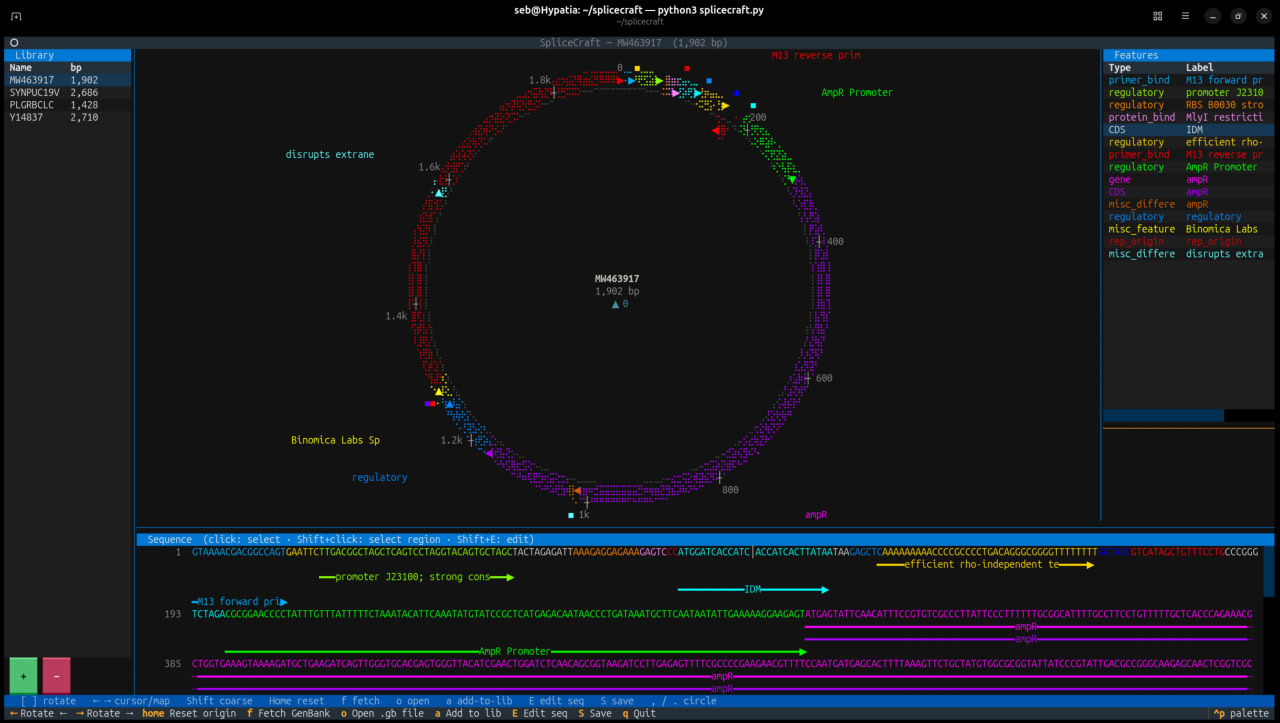
A terminal-based circular plasmid map viewer, sequence editor, primer design workbench, and Golden Braid parts domesticator — rendered entirely in your shell. Fetch any GenBank record by accession, load local files, annotate features with pLannotate, design diagnostic / cloning / Golden Braid primers with Primer3, and edit sequences — without ever leaving the terminal.
pipx install splicecraft
splicecraft              # empty canvas
splicecraft L09137       # fetch pUC19 from NCBI
splicecraft myplasmid.gb # open a local GenBank (.gb/.gbk) or SnapGene (.dna) file
That's it. pipx creates an isolated virtual environment for SpliceCraft
and its dependencies, so it won't clash with system Python packages. If you
don't have pipx yet: sudo apt install pipx on Debian/Ubuntu/WSL2,
brew install pipx on macOS, or python -m pip install --user pipx elsewhere.
User data lives in the platform-appropriate data directory (see the
Installation section below).
- Braille dot-matrix circular map — plasmids rendered as crisp Unicode braille rings with per-strand feature arcs, directional arrowheads, and proximity-placed labels
- Linear map view — toggle with
vfor a horizontal strip layout - Dithered sequence panel — per-base DNA viewer with feature bars, restriction site overlays, and double-stranded display
- Live NCBI fetch — pull any GenBank record by accession number on demand
- Local file support — open
.gb/.gbk(GenBank) or.dna(SnapGene native) files directly from disk - Free rotation — spin the origin left or right with
[/] - Restriction enzyme overlay — 200+ NEB enzymes including Type IIS (BsaI, BsmBI, BbsI, SapI) with visible recognition arcs + cut markers
- Plasmid library — SnapGene-style collection, auto-saves on import, survives restarts, supports rename and handslip-protected delete
- Parts Bin — Golden Braid L0 parts catalog with user-domesticated parts including sequences and primer pairs
- Primer library — all designed primers with Tm, length, date, status (Designed / Ordered / Validated), multi-select for batch operations
- Detection primers — diagnostic PCR; Primer3 picks the ideal pair within a selected region, 450-550 bp product by default (configurable)
- Cloning primers — RE-site tails + GCGC padding; 30+ common enzymes or type a custom recognition sequence
- Golden Braid primers — BsaI domestication for all L0 positions (Promoter, 5' UTR, CDS, CDS-NS, C-tag, Terminator)
- Generic primers — simple binding primers, no tails
- Primers can be added to the plasmid map as
primer_bindfeatures - Scrollable
TextAreafor custom sequence input; highlighted text = target
- pLannotate integration — press
Shift+A(or use the◈library button) to auto-annotate a plasmid against pLannotate's curated feature database. Optional — see install notes below
- Feature sidebar — click a row to highlight on map; click the map to select the feature under the cursor
- Undo/redo — 50-deep snapshot stack for all sequence edits
- Delete protection — focus-aware Delete key; confirmation modal (default focus = No) for library entries
- Clipboard — OSC-52 copy works in Windows Terminal, iTerm2, modern WSL
- Atomic saves — all JSON files written via tempfile +
os.replace - Automatic backups — every save writes
*.json.bakbefore overwriting - Corrupt-file recovery — missing files don't crash; corrupt files auto-
restore from
.bakwith a warning notification on startup
Requires Python 3.10+.
pipx install splicecraftpipx installs SpliceCraft (and its Textual / Biopython / primer3-py /
platformdirs deps) into an isolated virtual environment and places the
splicecraft command on your PATH. This is the right approach on
modern Debian, Ubuntu, Fedora, and WSL2, where pip install into the
system Python is blocked by PEP 668.
If you don't already have pipx:
sudo apt install pipx           # Debian / Ubuntu / WSL2
brew install pipx               # macOS
python -m pip install --user pipx  # everywhere else
pipx ensurepath # one-time; adds ~/.local/bin to PATHIf you prefer a plain pip workflow, use a virtual environment:
python3 -m venv ~/.venvs/splicecraft
~/.venvs/splicecraft/bin/pip install splicecraft
~/.venvs/splicecraft/bin/splicecraft
(Plain pip install splicecraft into system Python works on older
distros and inside conda envs, but will be rejected by PEP 668 on any
recent Debian-family system — use pipx or a venv instead.)
User data (library, parts bin, primers) lives in the platform-appropriate data directory:
| Platform | Path |
|---|---|
| Linux | ~/.local/share/splicecraft/ |
| macOS | ~/Library/Application Support/splicecraft/ |
| Windows | %APPDATA%\splicecraft\ |
Override with SPLICECRAFT_DATA_DIR=/path/to/dir splicecraft.
git clone https://github.com/Binomica-Labs/SpliceCraft.git
cd SpliceCraft
pip install -e . # inside a venv, or pass --break-system-packagespLannotate (for automatic plasmid annotation via Shift+A) — requires conda:
conda create -n plannotate -c conda-forge -c bioconda plannotate
conda activate plannotate
plannotate setupdb          # one-time ~500 MB BLAST database download
# then run SpliceCraft from the same conda env
SpliceCraft runs fine without pLannotate — the annotation feature just notifies the user how to install it if pressed.
splicecraft              # empty canvas
splicecraft L09137       # fetch pUC19 from NCBI on launch
splicecraft myplasmid.gb # open a local GenBank (.gb/.gbk) or SnapGene (.dna) file
splicecraft --version    # print version
splicecraft --help       # quick usage hint
If running from a git clone (pip install -e .), the same commands work;
you can also still run python3 splicecraft.py directly.
| Key | Description |
|---|---|
[ / ] |
Rotate map origin left / right |
Shift+[/] |
Rotate coarse (10× step) |
Home |
Reset origin to 0 |
, / . |
Circular map aspect wider / taller |
v |
Toggle circular ↔ linear map |
l |
Toggle feature label connector lines |
r |
Toggle restriction-site overlay |
f |
Fetch a record from NCBI by accession |
o |
Open a .gb file from disk |
a |
Add current plasmid to the library |
Shift+A |
Annotate plasmid with pLannotate |
Shift+E |
Enter sequence editor mode |
Shift+S |
Save edits to file |
Delete |
Context-aware delete (feature or library entry) |
Ctrl+Z |
Undo |
Ctrl+Shift+Z |
Redo |
Ctrl+C |
Copy selection to clipboard |
q |
Quit |
| Key | Description |
|---|---|
esc |
Close primer screen |
m |
Mark / unmark primer under cursor (★) |
M |
Mark / unmark all primers |
S |
Cycle status: Designed → Ordered → Validated |
Tab |
Cycle focus between fields |
| Action | Description |
|---|---|
| Click | Place cursor / select feature under pointer |
| Double-click | Select full feature span |
| Drag | Select a sequence range |
| Scroll wheel | Rotate map (when over map panel) |
| Menu | Items |
|---|---|
| File | Open .gb file · Fetch from NCBI · Add to Library · Save · Quit |
| Edit | Edit Sequence · Undo · Redo · Delete Feature |
| Enzymes | Show RE sites · Unique cutters · 6+/4+ bp sites · Connectors |
| Features | Add Feature · Delete Feature · Annotate with pLannotate |
| Primers | Opens the full-screen Primer Design workbench |
| Parts | Opens the Parts Bin (Golden Braid L0 parts catalog) |
| Constructor | Opens the Assembly Constructor for TU building |
| Package | Version | Purpose |
|---|---|---|
| Python | ≥ 3.10 | Runtime |
| Textual | ≥ 8.2.3 | TUI framework and rendering engine |
| Rich | ≥ 14.0 | Terminal rendering (Textual dependency) |
| Biopython | ≥ 1.87 | GenBank parsing and NCBI Entrez fetch |
| primer3-py | ≥ 2.3.0 | Primer design (Tm, thermodynamic screening) |
| pytest | ≥ 9.0 | Test suite (dev only) |
| pytest-asyncio | ≥ 1.3 | Async test support (dev only) |
| pLannotate | optional, conda | Automatic plasmid annotation (Shift+A) |
| BLAST+ | optional, conda | Required by pLannotate |
| Primer3 CLI | optional, apt |
Not used directly — primer3-py bundles it |
All user data persists as human-readable JSON in the repo directory:
| File | Purpose |
|---|---|
plasmid_library.json |
Saved plasmid collection (GenBank + metadata) |
parts_bin.json |
User-domesticated Golden Braid parts |
primers.json |
Designed primer library |
*.json.bak |
Automatic backup — written before each save |
These files are in .gitignore — they're user-local data, not repo content.
A manual backup rotation happens on every save so accidental data loss is
always recoverable via the .bak file.
python3 -m pytest -q          # full suite (246 tests, ~45 s)
python3 -m pytest tests/test_dna_sanity.py # biology correctness only (< 1s)MIT