███████╗ ██████╗ ██████╗ ██╗   ██╗████████╗
██╔════╝██╔════╝██╔═══██╗██║   ██║╚══██╔══╝
███████╗██║     ██║   ██║██║   ██║   ██║
╚════██║██║     ██║   ██║██║   ██║   ██║
███████║╚██████╗╚██████╔╝╚██████╔╝   ██║
╚══════╝ ╚═════╝ ╚═════╝  ╚═════╝    ╚═╝
An evidence-first AI research engine with scoped memory, graph intelligence, and agent execution.
Not a chatbot. Scout plans, searches, crawls, verifies, remembers useful context, reasons over graphs, executes safe tool workflows, and answers with evidence.






Most AI assistants follow a simple loop:
You ask → LLM answers
Fast. But fragile. The answer may sound confident while hiding uncertainty, missing sources, or using stale context.
Scout is different. Scout runs a full research and reasoning loop before it answers.
You ask
  ↓
Scout routes the request
  ↓
Scout recalls relevant memory
  ↓
Scout searches trusted sources
  ↓
Scout crawls and extracts evidence
  ↓
Scout reranks useful evidence
  ↓
Scout verifies claims
  ↓
Scout synthesizes a grounded answer
  ↓
Scout stores useful memory for future runs
Scout is built around one principle:
Answers should be backed by evidence, not vibes.
Scout is an AI research operating system.
It combines:
- evidence-first web research
- scoped memory
- source quality learning
- knowledge-base retrieval
- GitHub repository analysis
- repo graph construction
- graph report generation
- memory graph foundations
- safe Python sandbox execution
- worker-isolated runtime execution
- deterministic routing
- caching
- reranking
- agent executor workflows
- SSE progress streaming
- full eval harness
Scout is not trying to be a generic chatbot. It is designed to be a trustworthy research engine that can explain how it reached an answer.
| Capability | Status |
|---|---|
| Unified deterministic router | Complete |
| Evidence-first web research | Complete |
| Official-source seeded research | Complete |
| Multi-provider search | Complete |
| Local/direct URL fetch fallback | Complete |
| Bounded parallel research fan-out | Complete |
| Focused retry after weak grounding | Complete |
| Faithfulness critic | Complete |
| Scoped memory recall | Complete |
| Memory curator / sole writer | Complete |
| Memory dedupe | Complete |
| Memory tiers | Complete |
| Memory relevance gating | Complete |
| Source reuse memory | Complete |
| Blocked source memory | Complete |
| Knowledge-base retrieval | Complete |
| GitHub repo analysis | Complete |
| Repo graph build/query | Complete |
| Incremental repo graph update | Complete |
| Graph report generation | Complete |
| Graph report export API/UI hooks | Complete |
| Deterministic reranker | Complete |
| Evidence/memory/graph reranking | Complete |
| Intermediate result caching | Complete |
| Worker-isolated Python sandbox | Complete |
| Model service health checks | Complete |
| Agent executor scaffold | Complete |
| Multi-step deterministic agent planner | Complete |
| Agent run API + SSE progress | Complete |
| Reproducible Docker E2E stack | Complete |
| Memory Graph app UI | Next |
| Persistent agent runs | Later |
| LLM planner behind strict schema | Later |
| Swarm / multi-agent orchestration | Later |
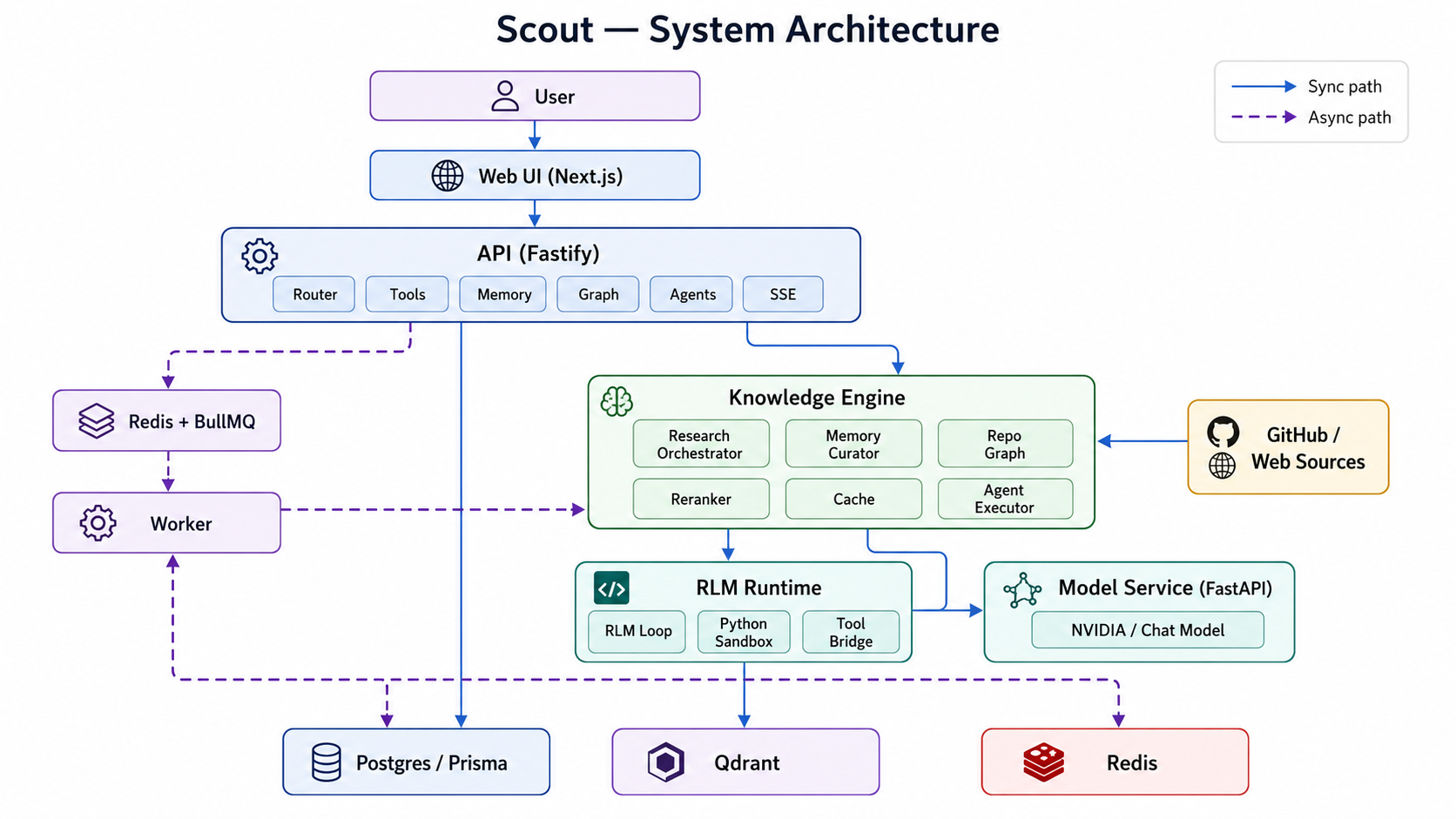
At a high level:
User
  ↓
Web UI
  ↓
API Router
  ↓
Intent Classifier
  ↓
Memory Recall + Cache + Reranker
  ↓
Tool / Research / Graph / Agent / Sandbox Route
  ↓
Worker / Runtime / Model Service
  ↓
Evidence + Trace + Debug
  ↓
Final Answer
Scout has two execution modes:
- Synchronous route execution for fast/direct paths.
- Queued worker execution for background or long-running jobs.
The user types a question in the frontend chat UI.
Example:
Compare Google Ads API and Meta Marketing API authentication with citations.
The frontend sends a request to the API with:
{
  "projectId": "a26d90b1-dc27-43de-a1dd-5c961d54ca0e",
  "userId": "optional-user-id",
  "query": "Compare Google Ads API and Meta Marketing API authentication with citations."
}The API calls the unified deterministic intent classifier:
packages/knowledge/src/router/intent-classifier.ts
The classifier returns:
{
  intent,
  tier,
  route,
  tool,
  confidence,
  normalizedQuery,
  signals,
  analysisAngles,
  reason,
  source
}
Example:
{
  "intent": "web_research",
  "tier": 2,
  "route": "research_orchestrator",
  "tool": "web_research",
  "confidence": 0.82,
  "signals": ["fresh_or_external_research"],
  "analysisAngles": [
    "Google Ads API authentication, permissions, rate limits, and docs",
    "Meta Marketing API authentication, permissions, rate limits, and docs"
  ],
  "reason": "Research/current/API/comparison query; use ResearchOrchestrator.",
  "source": "deterministic"
}Scout does not always recall memory.
Memory is skipped for pure code, pure sandbox, and pure graph routes when it is not needed.
Memory is used for:
- web research
- knowledge-base answers
- user preferences
- source quality
- blocked sources
- memoized repo follow-ups
- durable project context
This keeps latency low and avoids prompt pollution.
Scout caches expensive intermediate results, not final answers.
Cached surfaces:
provider_search
url_fetch
official_source
graph_report
Scout does not cache final synthesized answers.
This means repeated research gets faster without freezing stale responses.
Depending on route, Scout may call:
- ResearchOrchestrator
- search_kb
- github_repo
- query_graph
- sandbox
- agent executor
For web research, Scout:
plans subqueries
adds official source seeds
searches providers
ranks sources
fetches/crawls pages
extracts evidence
verifies citations
reranks evidence
synthesizes answer
runs critic
runs focused retry if needed
Long-running jobs can be queued.
API creates job
  ↓
API pushes job to Redis/BullMQ
  ↓
Worker picks job
  ↓
Worker calls runtime/research/tool layer
  ↓
Worker saves report/message/result
  ↓
Frontend reads result/progress
This is how Scout supports heavier workflows without blocking the UI.
Scout responses include answer content plus trace/debug fields.
Typical debug includes:
debug.routing
debug.memory
debug.memoryCurator
debug.cache
debug.rerank
debug.progress
debug.graph
debug.focusedRetry
debug.sandboxSafety
debug.agentExecutor
This makes Scout inspectable and eval-friendly.
Scout uses a tiered router.
Used for obvious low-cost answers.
Examples:
- knowledge-base lookup
- uploaded document lookup
- pure code answer
- insufficient-evidence response
- simple deterministic response
query → router → direct tool/model → answer
Used for external, current, API, comparison, and repo analysis questions.
Examples:
- web research
- GitHub repo analysis
- API docs comparison
- source-backed answer
query → router → ResearchOrchestrator / GitHub tool → answer
Used for graph, sandbox, and agent executor workflows.
Examples:
- query repo graph
- generate graph report
- run Python sandbox
- run explicit agent executor workflow
query → router → graph / sandbox / agent executor → answer
Scout's Research Engine v2 is the deterministic research backbone.
| Stage | Module | Purpose |
|---|---|---|
| Query planning | query-builder.ts / planner utilities |
Understand query and split into subqueries |
| Source planning | resource-planner.ts |
Combine official seeds, providers, and memory hints |
| Provider search | search-provider.ts |
Search Tavily/GitHub/local providers |
| Source ranking | source-ranker.ts |
Rank official, trusted, reference, and community sources |
| Memory-aware ranking | memory-ranking.ts |
Boost useful sources and penalize failed sources |
| Crawling/fetching | crawl-manager.ts, local-fetch.ts |
Fetch/crawl selected sources |
| Evidence extraction | evidence-extractor.ts |
Convert page text into claim-level evidence |
| Citation verification | citation-verifier.ts |
Mark claims supported, weak, or unsupported |
| Evidence packaging | evidence-pack.ts |
Package claims, citations, coverage, and gaps |
| Reranking | packages/knowledge/src/rerank |
Reorder evidence/memory/graph candidates |
| Answer synthesis | answer-synthesizer.ts |
Build grounded Markdown answer |
| Faithfulness critic | router/research critic path | Detect unsupported or missing claims |
| Focused retry | focused retry path | Recover only missing/weak evidence |
User query
  ↓
Intent classifier
  ↓
Memory policy
  ↓
Research plan
  ↓
Official source seeds
  ↓
Provider search
  ↓
Source ranking
  ↓
Bounded parallel crawl/fetch
  ↓
Evidence extraction
  ↓
Citation verification
  ↓
Evidence reranking
  ↓
Grounded answer synthesis
  ↓
Faithfulness critic
  ↓
Focused retry if needed
  ↓
Final answer
Scout injects official docs for known API/doc queries.
Examples:
| Query family | Seed |
|---|---|
| Google Ads API | Google Ads API docs |
| Meta Marketing API | Meta developer docs |
| WhatsApp Business Platform | Meta WhatsApp docs |
| GitHub REST API | GitHub REST docs |
This improves grounding when search providers return thin snippets or unreliable pages.
Scout can use multiple search/fetch providers.
| Provider | Purpose |
|---|---|
| Tavily | General web search |
| GitHub Search | Repo/source discovery |
| Local fetch | Direct URL and official docs fallback |
| Firecrawl | Optional fallback, disabled by default |
| Brave | Not used currently |
Relevant environment flags:
FIRECRAWL_ENABLED=false
TAVILY_ENABLED=true
GITHUB_SEARCH_ENABLED=true
LOCAL_CRAWL_ENABLED=true
BRAVE_SEARCH_ENABLED=false
Search providers are optional. Scout uses configured providers, deduplicates URLs, ranks sources, and falls back when providers fail.
Before M2.3, weak research answers could trigger a full second web research pass.
Now Scout uses focused retry.
first research pass
  ↓
critic detects missing/weak evidence
  ↓
focused retry only for missing anchors
  ↓
small resource budget
  ↓
merge if improved
Debug fields:
focusedRetryUsed
focusedRetryReason
focusedRetryAnchors
focusedRetryMaxResources
focusedRetryMs
focusedRetryImproved
focusedRetryOriginalScore
focusedRetryFinalScore
This reduces latency and provider cost.
Scout has a scoped, curated memory system.
Memory is not just a log. It changes future behavior.
Main source:
packages/knowledge/src/memory/
preference
fact
durable_fact
source_quality
source_failure
decision
task_trace
M4 introduced tiered memory.
working
episodic
semantic
procedural
| Kind | Tier |
|---|---|
preference |
semantic |
durable_fact |
semantic |
source_quality |
procedural |
source_failure |
procedural |
decision |
episodic |
task_trace |
episodic |
Only the memory curator writes memories.
MemoryManager.addMany()
  ↓
curateAndWriteMemories()
  ↓
Prisma memory write
This prevents random routes/tools from polluting memory.
Scout dedupes memories using a SHA-256 hash:
projectId + userId + scope + kind + normalizedText + sourceUrls
This prevents duplicate memory rows from repeated runs.
Durable facts require provenance.
If a memory is a durable fact but has no sourceUrls, the curator rejects it.
This prevents unsupported claims from becoming permanent memory.
Recall is relevance-gated.
MEMORY_RECALL_MIN_SCORE=0.2
MEMORY_RECALL_MAX_CONTEXT=8
Scout recalls memories for:
- source ranking
- preferences
- source reuse
- blocked source avoidance
- project decisions
- repo follow-ups
- KB/direct-model context
Memory is labeled as context, not evidence.
Scout does not cite memory as evidence unless source URLs are attached.
Scout supports the architecture for memory upload through the curator.
Expected flow:
User uploads memory text
  ↓
API validates memory payload
  ↓
MemoryManager.addMany()
  ↓
Memory Curator
  ↓
dedupe + provenance checks + tier inference
  ↓
Postgres memory write
  ↓
UI shows written/skipped counts
Memory upload should never directly write Prisma memory rows.
Scout already has the backend foundation for memory graph views:
- memory kinds
- memory tiers
- scopes
- source URLs
- entities
- metadata
- curator versions
The dedicated Memory Graph UI is planned next.
Expected Memory Graph app:
Memory nodes
  ↓
edges by shared entities / source URLs / kind / tier
  ↓
filters by tier, kind, scope, source-backed
  ↓
detail panel for selected memory
Memory Graph is separate from Repo Graph.
Scout can analyze repositories and build a codebase graph.
Main source:
packages/knowledge/src/graph/
Repo graph stores:
Entity
Relation
Report
Examples of entities:
file
service
module
function
class
package
runtime component
Examples of relations:
imports
calls
depends_on
owns
uses_tool
routes_to
generates
GitHub repo URL
  ↓
repo analyzer fetches files
  ↓
repo graph builder extracts entities/relations
  ↓
Postgres stores Entity/Relation rows
  ↓
query_graph can answer architecture questions
  ↓
graph report generator creates GRAPH_REPORT.md
Scout can generate repo graph reports with:
- repo overview
- key services
- important packages
- important files
- high-degree nodes
- relation type counts
- architecture paths
- suggested follow-up questions
Graph report export endpoints:
GET /graph-reports/latest
GET /graph-reports/:reportId
GET /graph-reports/:reportId/download.md
M5 added a unified deterministic reranker.
Source:
packages/knowledge/src/rerank/
Wired surfaces:
evidence
memory
repo_graph
Current reranker uses:
lexical overlap
base score
official/source quality boost
freshness boost
surface-specific boost
LLM reranker exists but is disabled by default:
RERANKER_LLM_ENABLED=falseThis gives Scout a clean place to plug in future embedding or cross-encoder reranking.
M6 added intermediate result caching.
Source:
packages/knowledge/src/cache/
Cached surfaces:
provider_search
url_fetch
official_source
graph_report
Scout does not cache final answers.
This protects answer freshness while reducing repeated provider/fetch work.
Example cache debug:
{
  "cacheEnabled": true,
  "searchCacheHit": true,
  "fetchCacheHit": false
}
Known limitation:
- current cache is in-memory
- cache resets on process restart
- Redis adapter can be added later
Scout has a typed, budgeted agent executor.
Source:
packages/knowledge/src/agent/
Current agent design:
single-agent
deterministic-first
budgeted
traceable
flag-gated
existing tools only
Default:
AGENT_EXECUTOR_ENABLED=falseExplicit agent query
↓
router checks AGENT_EXECUTOR_ENABLED
↓
deterministic planner builds AgentPlan
↓
executor validates budgets
↓
tool adapter runs steps
↓
trace events emitted
↓
result returned
M10 added deterministic multi-step planning.
Example query:
Use agent executor to compare Google Ads API and Meta Marketing API authentication.
Plan:
Step 1 → web_research Google Ads API
Step 2 → web_research Meta Marketing API
Step 3 → aggregate final answer
Current limits:
AGENT_EXECUTOR_MAX_STEPS=6
AGENT_EXECUTOR_MAX_TOOL_CALLS=10
AGENT_EXECUTOR_TIMEOUT_MS=180000M10 added SSE agent progress endpoints.
POST /agents/runs
GET /agents/runs/:runId
GET /agents/runs/:runId/events
Progress events:
agent_started
step_started
step_completed
step_failed
budget_exceeded
agent_completed
agent_failed
Current limitation:
- agent run store is in-memory
- persistent runs are planned later
Scout uses an RLM runtime with Python sandbox execution.
Source:
apps/rlm-runtime/
The sandbox can execute dynamic Python/tool code with budgets and isolation.
M7 added:
SandboxBudget
SandboxSafetyDebug
stdout cap
stderr cap
tool-call budget
soft timeout
best-effort global isolation
Example safety debug:
{
  "budget": {
    "timeoutMs": 30000,
    "maxStdoutChars": 20000,
    "maxStderrChars": 10000,
    "maxToolCalls": 12
  },
  "timedOut": false,
  "killed": false,
  "stdoutSize": 1234,
  "stderrSize": 0,
  "stdoutTruncated": false,
  "stderrTruncated": false,
  "toolCallCount": 3,
  "toolCallLimitHit": false,
  "isolationMode": "best_effort_globals"
}M7 timeout was soft because in-process Pyodide could continue running after Promise.race.
M8 moved sandbox execution to a killable worker.
Default:
RLM_SANDBOX_ISOLATION_MODE=workerFallback:
RLM_SANDBOX_ISOLATION_MODE=in_processWorker timeout behavior:
parent starts worker
  ↓
worker runs Pyodide
  ↓
timeout occurs
  ↓
parent calls worker.terminate()
  ↓
safety.timedOut=true
  ↓
safety.killed=true
This gives Scout real termination semantics for CPU-bound Python.
Model service lives in:
apps/model-service/
It is a FastAPI service for model calls and model-related utilities.
Current NVIDIA model setup:
provider: NVIDIA
model: z-ai/glm-5.1
M9.5 fixed the ChatNVIDIA/pydantic compatibility issue.
Working versions:
Python: 3.13.5
pydantic: 2.13.4
langchain-core: 0.3.86
langchain-nvidia-ai-endpoints: 0.3.19
Health endpoints:
GET /health
GET /health/model
Expected:
{
  "status": "ok",
  "provider": "nvidia",
  "model": "z-ai/glm-5.1"
}Scout uses Redis and BullMQ for background execution.
Worker flow:
API creates job
  ↓
job saved in Postgres
  ↓
job pushed to Redis/BullMQ
  ↓
worker picks job
  ↓
worker calls runtime/research/tool layer
  ↓
worker writes result/report/message
  ↓
frontend displays result
This supports long research jobs, report generation, and future async agent workflows.
apps/web
  ├── Chat UI
  ├── Research debug panels
  ├── Composer
  ├── Apps drawer
  ├── Graph report UI
  └── Future memory graph / agent progress UI

        ↓ HTTP

apps/api
  ├── Router
  ├── Tool routes
  ├── Memory routes
  ├── Graph report routes
  ├── Agent run routes
  ├── SSE progress endpoint
  └── Prisma access

        ↓ queue / direct call

Redis + BullMQ
  ├── job queue
  └── job state

        ↓

apps/worker
  ├── picks jobs
  ├── calls runtime/research
  └── saves results

        ↓

apps/rlm-runtime
  ├── RLM loop
  ├── worker-isolated Python sandbox
  ├── tool bridge
  └── answer critic

        ↓

apps/model-service
  ├── FastAPI
  ├── ChatNVIDIA
  └── model health checks

        ↓

packages/knowledge
  ├── research engine
  ├── memory curator
  ├── repo graph
  ├── cache
  ├── reranker
  ├── agent executor
  └── answer synthesis

        ↓

Storage
  ├── Postgres / Prisma
  ├── Qdrant
  └── Redis
| Layer | Technology | Responsibility |
|---|---|---|
| Frontend UI | Next.js, Tailwind CSS | Chat, debug panels, app shell, graph/report views |
| Central API | Fastify, TypeScript, Prisma | Routing, tools, memory, graph reports, agent runs |
| Worker | Node.js, BullMQ | Background job execution |
| Runtime | Deno/TypeScript, Pyodide Worker | Safe dynamic reasoning and sandboxed tool execution |
| Model Service | FastAPI, ChatNVIDIA | Model calls and model health |
| Research Engine | TypeScript | Search, crawl, evidence, synthesis, critic |
| Memory System | TypeScript + Postgres | Scoped curated memory |
| Graph System | TypeScript + Postgres | Repo graph, entities, relations, graph reports |
| Vector Store | Qdrant | Semantic retrieval over documents |
| Database | Postgres / Prisma | Projects, jobs, reports, memories, graph |
| Queue / Cache | Redis | BullMQ jobs and async state |
| Cache Layer | In-memory now, Redis later | Intermediate provider/fetch/report caching |
scout/
├── apps/
│   ├── api/                    # Fastify API, router, tools, graph, agent endpoints
│   ├── model-service/          # FastAPI + ChatNVIDIA/model utilities
│   ├── rlm-runtime/            # Worker-isolated sandbox/tool runtime
│   ├── web/                    # Next.js frontend
│   └── worker/                 # BullMQ worker
│
├── packages/
│   ├── knowledge/              # Research, memory, graph, rerank, cache, agents
│   ├── retrieval/              # Vector retrieval over documents
│   ├── database/               # Prisma/Postgres client
│   ├── clients/                # Shared clients
│   └── queue/                  # Queue helpers
│
├── harness/
│   └── eval/                   # Eval harness, phase cases, manual cases
│
├── harness-runs/               # Local eval outputs, gitignored
├── docs/                       # Architecture, planning, reports, testing
├── scripts/                    # DB setup, seeding, maintenance
├── docker-compose.yml
└── README.md
Research pipeline.
answer-mode.ts
answer-renderers.ts
answer-synthesizer.ts
citation-verifier.ts
crawl-manager.ts
evidence-extractor.ts
evidence-pack.ts
query-builder.ts
resource-planner.ts
search-provider.ts
source-ranker.ts
research-orchestrator.ts
Curated memory system.
memory-manager.ts
memory-types.ts
memory-curator.ts
Repo graph and graph report logic.
repo-graph-builder.ts
repo-graph-query.ts
repo-graph-report.ts
project-context-graph.ts
Deterministic reranking.
reranker-types.ts
deterministic-reranker.ts
llm-reranker.ts
Intermediate result caching.
cache-types.ts
cache-key.ts
in-memory-cache.ts
cache-manager.ts
Agent executor scaffold and deterministic planning.
agent-types.ts
deterministic-planner.ts
agent-executor.ts
- Docker + Docker Compose v2+
- Node.js
- npm
- Python only if running model-service locally outside Docker
npm run stack:upOr manually:
docker compose up -d --build postgres redis qdrant model-service rlm-runtime api workerdocker compose psHealth checks:
curl -s http://localhost:8000/health | jq .
curl -s http://localhost:8000/health/deps | jq .
curl -s http://localhost:8100/health | jq .
curl -s http://localhost:8100/health/model | jq .
curl -s http://localhost:6333/healthz || true./scripts/setup-e2e-db.shSeed eval project:
npm run db:seed:evalDefault eval project:
a26d90b1-dc27-43de-a1dd-5c961d54ca0e
Core:
DATABASE_URL=postgresql://postgres:postgres@postgres:5432/scout?schema=public
REDIS_URL=redis://redis:6379
QDRANT_URL=http://qdrant:6333
MODEL_SERVICE_URL=http://model-service:8100
Research/provider:
FIRECRAWL_ENABLED=false
TAVILY_ENABLED=true
GITHUB_SEARCH_ENABLED=true
LOCAL_CRAWL_ENABLED=true
BRAVE_SEARCH_ENABLED=false
Runtime:
RLM_SANDBOX_ISOLATION_MODE=worker
RLM_SANDBOX_TIMEOUT_MS=30000
RLM_SANDBOX_MAX_STDOUT_CHARS=20000
RLM_SANDBOX_MAX_STDERR_CHARS=10000
RLM_SANDBOX_MAX_TOOL_CALLS=12
Research performance:
RESEARCH_PARALLELISM=4
FOCUSED_RETRY_MAX_RESOURCES=4
FOCUSED_RETRY_TIMEOUT_MS=45000
Memory:
MEMORY_RECALL_MIN_SCORE=0.2
MEMORY_RECALL_MAX_CONTEXT=8
Cache:
SCOUT_CACHE_ENABLED=trueReranker:
RERANKER_LLM_ENABLED=falseRouter LLM classifier:
ROUTER_LLM_INTENT_ENABLED=falseAgent executor:
AGENT_EXECUTOR_ENABLED=false
AGENT_EXECUTOR_MAX_STEPS=6
AGENT_EXECUTOR_MAX_TOOL_CALLS=10
AGENT_EXECUTOR_TIMEOUT_MS=180000
AGENT_EXECUTOR_SSE_ENABLED=trueRun full CI eval:
npm run eval:ciRun Phase 2 memory/context evals:
npm run eval:phase2Run Phase 3 graph evals:
npm run eval:phase3Run routing-intent evals:
npm run eval:routing-intentAnalyze latest run:
LATEST=$(ls -td harness-runs/* | head -1)
npm run eval:analyze -- "$LATEST"
cat "$LATEST/analysis.md"npm run typecheck:api
npm run typecheck:knowledge
npm run typecheck:web
AGENT_EXECUTOR_ENABLED=false \
FIRECRAWL_ENABLED=false \
SCOUT_CACHE_ENABLED=true \
RESEARCH_PARALLELISM=4 \
FOCUSED_RETRY_MAX_RESOURCES=4 \
FOCUSED_RETRY_TIMEOUT_MS=45000 \
ROUTER_LLM_INTENT_ENABLED=false \
RERANKER_LLM_ENABLED=false \
MEMORY_RECALL_MIN_SCORE=0.2 \
MEMORY_RECALL_MAX_CONTEXT=8 \
RLM_SANDBOX_ISOLATION_MODE=worker \
npm run eval:ci
AGENT_EXECUTOR_ENABLED=false \
FIRECRAWL_ENABLED=false \
SCOUT_CACHE_ENABLED=true \
RESEARCH_PARALLELISM=4 \
FOCUSED_RETRY_MAX_RESOURCES=4 \
FOCUSED_RETRY_TIMEOUT_MS=45000 \
ROUTER_LLM_INTENT_ENABLED=false \
RERANKER_LLM_ENABLED=false \
MEMORY_RECALL_MIN_SCORE=0.2 \
MEMORY_RECALL_MAX_CONTEXT=8 \
RLM_SANDBOX_ISOLATION_MODE=worker \
npm run eval:phase2
AGENT_EXECUTOR_ENABLED=false \
FIRECRAWL_ENABLED=false \
SCOUT_CACHE_ENABLED=true \
RESEARCH_PARALLELISM=4 \
FOCUSED_RETRY_MAX_RESOURCES=4 \
FOCUSED_RETRY_TIMEOUT_MS=45000 \
ROUTER_LLM_INTENT_ENABLED=false \
RERANKER_LLM_ENABLED=false \
MEMORY_RECALL_MIN_SCORE=0.2 \
MEMORY_RECALL_MAX_CONTEXT=8 \
RLM_SANDBOX_ISOLATION_MODE=worker \
npm run eval:phase3
AGENT_EXECUTOR_ENABLED=false \
FIRECRAWL_ENABLED=false \
SCOUT_CACHE_ENABLED=true \
RESEARCH_PARALLELISM=4 \
FOCUSED_RETRY_MAX_RESOURCES=4 \
FOCUSED_RETRY_TIMEOUT_MS=45000 \
ROUTER_LLM_INTENT_ENABLED=false \
RERANKER_LLM_ENABLED=false \
MEMORY_RECALL_MIN_SCORE=0.2 \
MEMORY_RECALL_MAX_CONTEXT=8 \
RLM_SANDBOX_ISOLATION_MODE=worker \
npm run eval:routing-intentcurl -X POST http://localhost:8000/tools/web-research \
-H "Content-Type: application/json" \
-d '{
"projectId":"a26d90b1-dc27-43de-a1dd-5c961d54ca0e",
"query":"Compare Meta Marketing API and Google Ads API permissions and rate limits",
"maxResults":5,
"maxPagesPerSource":3,
"maxTotalPages":12,
"maxDepth":1,
"useOrchestrator":true
}'Expected response includes:
subqueries
resourcesPlanned
documents
failedCrawls
evidencePack
citationVerification
memories
answer.markdown
answer.citations
answer.confidence
Agent executor is disabled by default.
Enable it for manual tests:
AGENT_EXECUTOR_ENABLED=trueRun direct router test:
curl -s -X POST http://localhost:8000/router/answer \
  -H "Content-Type: application/json" \
  -d '{
    "projectId":"a26d90b1-dc27-43de-a1dd-5c961d54ca0e",
    "query":"Use agent executor to compare Google Ads API and Meta Marketing API authentication with citations."
  }' | jq '.debug.agentExecutor, .ui.agent'
Expected:
agentExecutorUsed=true
stepCount >= 1
status completed or tool-level failure
Create run:
RUN_ID=$(curl -s -X POST http://localhost:8000/agents/runs \
  -H "Content-Type: application/json" \
  -d '{
    "projectId":"a26d90b1-dc27-43de-a1dd-5c961d54ca0e",
    "query":"Use agent executor to compare Google Ads API and Meta Marketing API authentication with citations."
  }' | jq -r '.runId')
Stream events:
curl -N "http://localhost:8000/agents/runs/$RUN_ID/events"Expected events:
agent_started
step_started
step_completed
agent_completed
Fetch latest graph report:
curl "http://localhost:8000/graph-reports/latest?projectId=a26d90b1-dc27-43de-a1dd-5c961d54ca0e" | jq .Download Markdown:
curl "http://localhost:8000/graph-reports/latest?projectId=a26d90b1-dc27-43de-a1dd-5c961d54ca0e&format=md" \
  -o GRAPH_REPORT.md

head -40 GRAPH_REPORT.md{
"status": "ok",
"query": "Compare Meta Marketing API and Google Ads API permissions and rate limits",
"subqueries": [
{
"query": "Meta Marketing API permissions",
"reason": "Find source-specific permission details",
"priority": 1
}
],
"resourcesPlanned": [
{
"title": "Meta Marketing API Documentation",
"url": "https://developers.facebook.com/docs/marketing-apis/",
"tier": "official_docs",
"score": 128,
"matchedBy": ["registry", "memory:source_quality:+16"]
}
],
"evidencePack": {
"coverage": {
"hasEvidence": true,
"claimCount": 14,
"supportedClaimCount": 11,
"weakClaimCount": 3,
"unsupportedClaimCount": 2
}
},
"answer": {
"mode": "comparison",
"status": "answered",
"confidence": 0.91,
"markdown": "## Answer\n\n...",
"citations": [
{
"id": 1,
"title": "Meta Marketing API Documentation",
"url": "https://developers.facebook.com/docs/marketing-apis/",
"tier": "official_docs",
"usedClaims": 4
}
]
}
}Unsupported claims are never used in final answer synthesis.
Problem:
Firecrawl/provider instability caused grounding and reliability failures.
Fix:
Firecrawl optional/off
Tavily/GitHub/local fetch fallback
official source seeds
provider debug
focused recovery
Problem:
Memory/report writes failed when eval project rows were missing.
Fix:
project upsert/seed
M9.6 reproducible E2E stack
DB setup script
eval project seed script
Problem:
Old global memories leaked across evals and polluted answers.
Fix:
scoped memory recall
project/user isolation
memory curator
dedupe
relevance gate
Problem:
Answers sometimes included weak or unsupported claims.
Fix:
evidence verification
faithfulness critic
focused retry
unsupported claim omission
Problem:
Important files like worker/runtime nodes got buried by UUID order and result limits.
Fix:
larger DB take limits
stopword cleanup
token-aware sorting
file bonus
deterministic tie-breaking
Problem:
Subquery/provider/fetch loops were too serial.
Fix:
bounded concurrency
RESEARCH_PARALLELISM=4
caching
focused retry
Problem:
Intent routing lived in multiple places.
Fix:
unified deterministic intent classifier
debug.routing everywhere
optional LLM classifier disabled
Problem:
Pyodide could run forever, print forever, call tools forever, and leak state.
Fix:
sandbox budgets
stdout/stderr caps
tool-call budget
worker isolation
worker.terminate() hard kill
Problem:
ChatNVIDIA/pydantic compatibility error blocked E2E model service.
Fix:
aligned pydantic/langchain-core/langchain-nvidia-ai-endpoints versions
added /health/model
added startup self-test
Problem:
Agent/manual tests needed Postgres, Redis, Qdrant, model-service, API, runtime, and worker all healthy.
Fix:
Docker compose stack
setup-e2e-db.sh
seed-eval-project.mjs
M9.6 baseline
health checks
- Keep route handlers thin.
- Keep modules small and single-purpose.
- Prefer deterministic stages before LLM polish.
- Do not let final answers introduce unsupported facts.
- Memory should guide behavior, not become hidden evidence.
- Every answer should be traceable back to evidence.
- Every new feature must expose debug signals.
- Every milestone must keep eval gates green.
- Avoid swarms until the single-agent path is stable.
- Prefer typed contracts and explicit budgets.
- Expensive work should be cached or queued.
- Unsafe runtime execution must be isolated and killable.
- Tiered router
- Unified deterministic intent classifier
- Evidence-first ResearchOrchestrator
- Source relevance gate
- News/API/comparison query handling
- Faithfulness critic
- Harness with reward + trajectories
- CI eval gate
- Scoped memory recall
- Blocked source memory
- Source reuse
- Bounded evidence recovery
- Focused retry
- Bounded parallelization
- Lazy memory recall
- Progress event scaffold
- Memory curator
- Memory dedupe
- Memory tiers
- Relevance-gated memory recall
- Repo graph builder
- Repo graph query
- Incremental graph update
- Graph report generation
- Graph report export API
- Deterministic reranker
- Evidence/memory/graph reranking
- Intermediate result caching
- Sandbox budgets
- Worker-isolated sandbox
- Model-service NVIDIA compatibility fix
- Agent executor scaffold
- Multi-step deterministic agent planner
- Agent run API
- Agent SSE progress endpoint
- Reproducible E2E eval stack
- Composer plus menu
- Document upload UI
- Memory upload UI
- Apps drawer
- Memory Graph app
- Repo Graph app
- Agent Runs UI
- Settings modal
- Account menus
- Persistent agent runs
- Agent progress UI polish
- LLM planner behind strict schema
- Redis cache adapter
- True semantic/cross-encoder reranker
- Memory graph layout polish
- Parallel agent step execution
- MCP/connectors with safety rules
- Swarm/multi-agent orchestration
- Self-learning loop after eval coverage
Scout is in active development.
Current foundation is stable:
router
research
memory
graph
cache
rerank
sandbox
model-service
agent executor
E2E stack
Next product milestone is the UI layer:
ChatGPT-like shell
Apps section
Memory Graph
Document upload
Memory upload
Agent progress
Settings
The backend can already think deeply. The next step is making it feel like a polished product.
Built to think deeper. Research further. Answer with evidence.